

Evernorth’s Unrealized XRP Losses Highlight Growing Pressure on Digital Asset Treasury Firms
- Recent crypto market downturn is impacting firms holding large digital asset reserves.
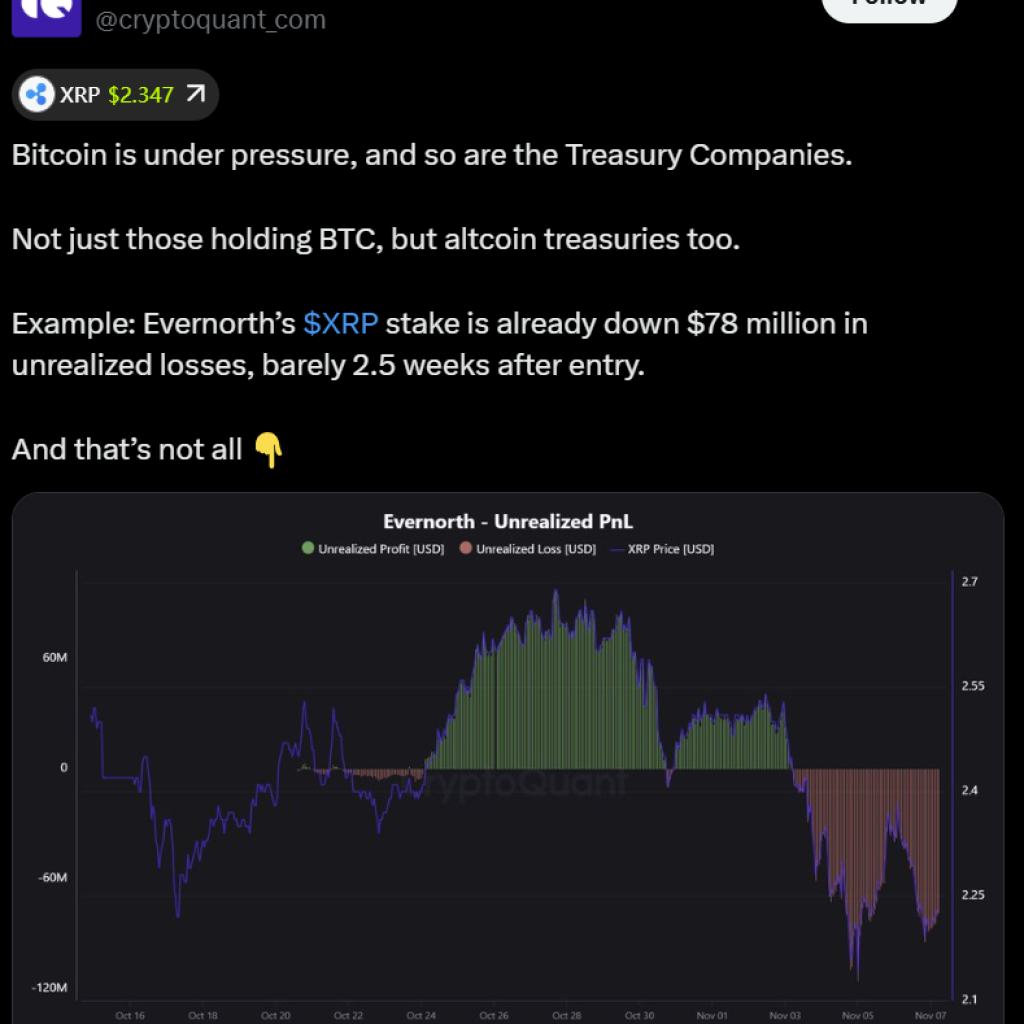
- Evernorth is facing around $78 million in unrealized losses from its XRP holdings.
- Strategy and BitMine are also seeing valuation pressure linked to their crypto exposure.
- Analysts warn only the strongest digital asset treasury companies may survive long-term.
The recent decline in the cryptocurrency market has not only affected major assets like Bitcoin and Ether, but it has also placed significant pressure on companies whose business models rely on holding digital assets in their treasuries. One of the clearest examples is Evernorth, a firm focused on accumulating large amounts of XRP.
According to new analysis from CryptoQuant, Evernorth has experienced around $78 million in unrealized losses on its XRP position, even though the purchase occurred only a few weeks ago. This demonstrates how quickly market conditions can shift and how vulnerable digital asset treasury companies can be when prices fall over short periods of time.
The downturn has also affected Strategy (MSTR), a well-known company recognized for accumulating Bitcoin as part of its corporate strategy. The company’s stock value has dropped more than 26% over the past month as Bitcoin’s price has fallen. While Strategy still holds a significant unrealized gain due to an average cost basis of around $74,000 per Bitcoin, the recent price declines have clearly impacted investor sentiment.
Another major example is BitMine, the largest corporate holder of Ether. Reports show that BitMine is currently sitting on unrealized losses of approximately $2.1 billion connected to its Ethereum holdings. The company now holds close to 3.4 million ETH, including more than 565,000 acquired recently. As market prices shift, these large on-balance-sheet positions can quickly influence corporate valuations.
This situation has brought renewed attention to digital asset treasury companies, often referred to as DATs. Analysts note that many of these companies are now facing pressure because their valuations are closely tied to the market value of their crypto reserves. When prices are rising, these companies can appear strong and profitable. But when the market falls, the risks become more visible, similar to past financial cycles like the dot-com boom and bust.
Some analysts believe that only the strongest companies with clear long-term strategies will survive. Bitcoin-focused treasuries, in particular, may be better positioned due to the perceived stability and maturity of Bitcoin compared to other digital assets. Others caution that many firms built around aggressive asset accumulation could struggle or fail if market weakness continues.
Overall, the current market environment is testing the sustainability of treasury-focused crypto business models and showing how market cycles can reshape corporate strategies built on digital assets.
Final Thought
The performance of digital asset treasury companies is becoming directly tied to crypto price movements, making the current downturn a major stress test. The outcome may define which companies are built for long-term resilience and which were only prepared for bull market conditions.