
2,000 Bitcoin on the Move: Rare Casascius Coins Wake Up After 13 Years
- Two Casascius coins, each holding 1,000 BTC, were activated after 13 years.
- The coins were minted when Bitcoin cost just $3.88 and $11.69.
- These physical coins were part of a rare batch created between 2011–2013.
- Only a few 1,000-BTC coins/bars were ever made, making them extremely rare.
- Redeeming the coins doesn’t mean the BTC will be sold immediately.
- Some holders simply move funds for security — not for profit-taking.
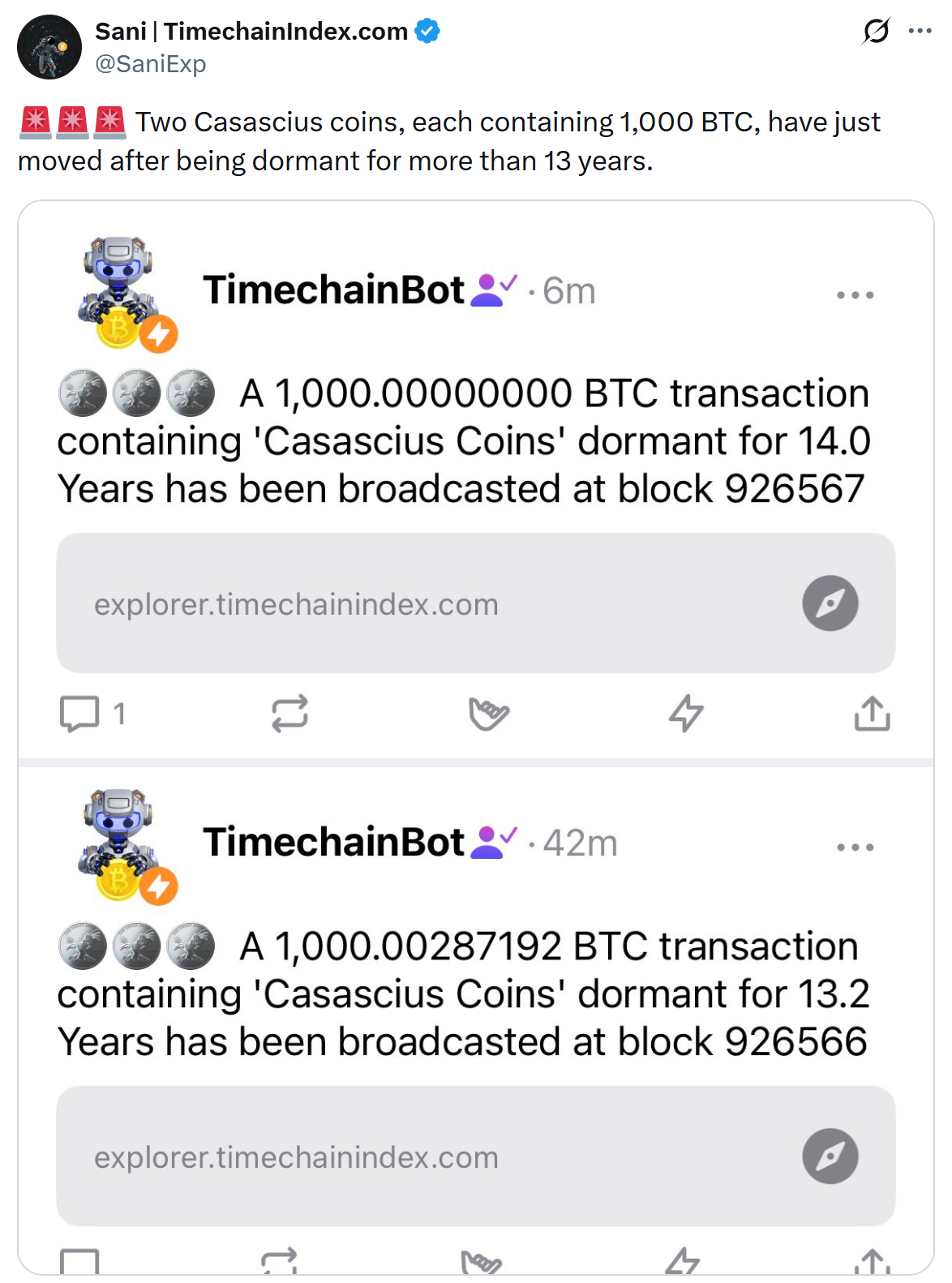
Two of the most legendary physical Bitcoin collectibles — Casascius coins — have come back to life. On Friday, blockchain data showed that two long-dormant coins, each loaded with 1,000 BTC, moved for the first time in over 13 years. That’s over $179 million suddenly unlocked.
One coin was minted in December 2011, when Bitcoin was trading at only $3.88. The other was minted in October 2012, when BTC cost about $11.69. If you do the math, the return on that 2011 coin is astronomical — a millions-percent gain, not even counting the tiny cost of minting.
These coins come from the early days of BTC. Between 2011 and 2013, an entrepreneur named Mike Caldwell created Casascius coins and bars — physical metal coins with embedded private keys, covered by tamper-resistant holograms. They were available in denominations like 1, 5, 10, 25, 100, 500 and 1,000 BTC. But after a letter from regulators (FinCEN), he shut down the project.
Of those, only a few 1,000-BTC coins and bars were ever made: some records show 16 bars and 6 coins in that size. That makes every movement of these coins a newsworthy event — extremely rare and closely watched.
Importantly: when someone redeems a Casascius coin — by peeling off the hologram and using the private key — the coin loses its value and the BTC moves to a digital wallet. But that doesn’t automatically mean a sell-off. Past holders, like one referred to as “John Galt,” moved their BTC to hardware wallets simply for security — not to dump. As he put it: “Having 100 BTC is life-changing… but this was more about staying safe than suddenly getting rich.”
So while these two 1,000-BTC coins now sit dormant no more, that doesn’t necessarily mean the market will feel a wave of selling pressure. It could just be a shift from old-school physical cold storage to modern crypto wallets.
Final Thought
The reactivation of these rare Casascius coins is a powerful reminder of Bitcoin’s humble beginnings and massive potential. Even after more than a decade, these coins still carry huge value — not just in BTC, but in history. And while the movement of such large holdings draws attention, it doesn’t always translate into market action. Often, it’s about security, preservation, and adapting to today’s crypto world.