

Ether Exchange Balances Fall to 8.7% – Looming Supply Squeeze as ETH Moves Off Exchanges
- Ether on centralized exchanges fell to 8.7%, the lowest level since 2015.
- Exchange ETH balances dropped 43% since July, driven by staking, restaking, L2 activity, DATs, and custody.
- Analysts warn this could create a supply squeeze that supports future price gains.
- On-Balance Volume (OBV) shows a momentum breakout — hidden buying strength despite price rejection.
- ETH is holding above $3,000, with resistance near $3,200 and bullish ETH/BTC signals emerging.
ETH exchange balances hit decade lows
The amount of Ether stored on centralized exchanges has dropped to 8.7%, according to Glassnode — the lowest level recorded since Ethereum’s launch in 2015. By the following weekend the figure remained about 8.8%, confirming the trend is ongoing and not a one-day data blip.
This sharp fall in exchange reserves means there is less readily available ETH to sell on short notice. Analysts and market observers say this structural change increases the chance of a supply squeeze if demand picks up.
Exchange ETH balances have fallen 43% since early July. That period coincides with a rise in digital asset treasury (DAT) purchases and increasing institutional and protocol-level demand. In other words, a large share of ETH has moved into places where it is unlikely to be sold quickly.
Where the ETH is going — locked and less liquid
Multiple destinations are absorbing ETH and taking it off exchanges:
Staking and restaking
ETH staked on the Beacon Chain and restaked via protocols like EigenLayer is locked to secure networks and earn yield. Staked ETH is far less likely to be moved back to exchanges quickly.
Layer-2s and protocol activity
Layer-2 networks (Arbitrum, Optimism, Base, etc.) require ETH for gas and bridging. Increased L2 activity means ETH sits in bridges, vaults, and contracts rather than on exchanges.
DATs, custody, and collateral loops
Institutions and treasuries are buying ETH for long-term holdings. Custodial solutions and collateral strategies also lock ETH away, further shrinking liquid supply.
Milk Road commented that “ETH is quietly entering its tightest supply environment ever,” highlighting how supply-side scarcity is building while market sentiment may still appear muted.
Technical signs: OBV shows hidden buying strength
Technical analyst Sykodelic flagged an On-Balance Volume (OBV) breakout above resistance. OBV measures money flow into an asset and can reveal accumulation even when price stalls.
Why OBV matters now
Although price was rejected after a breakout attempt, rising OBV amid price weakness often points to hidden accumulation. Traders use this divergence as an early signal that institutional buying or stealth accumulation is happening behind the scenes.
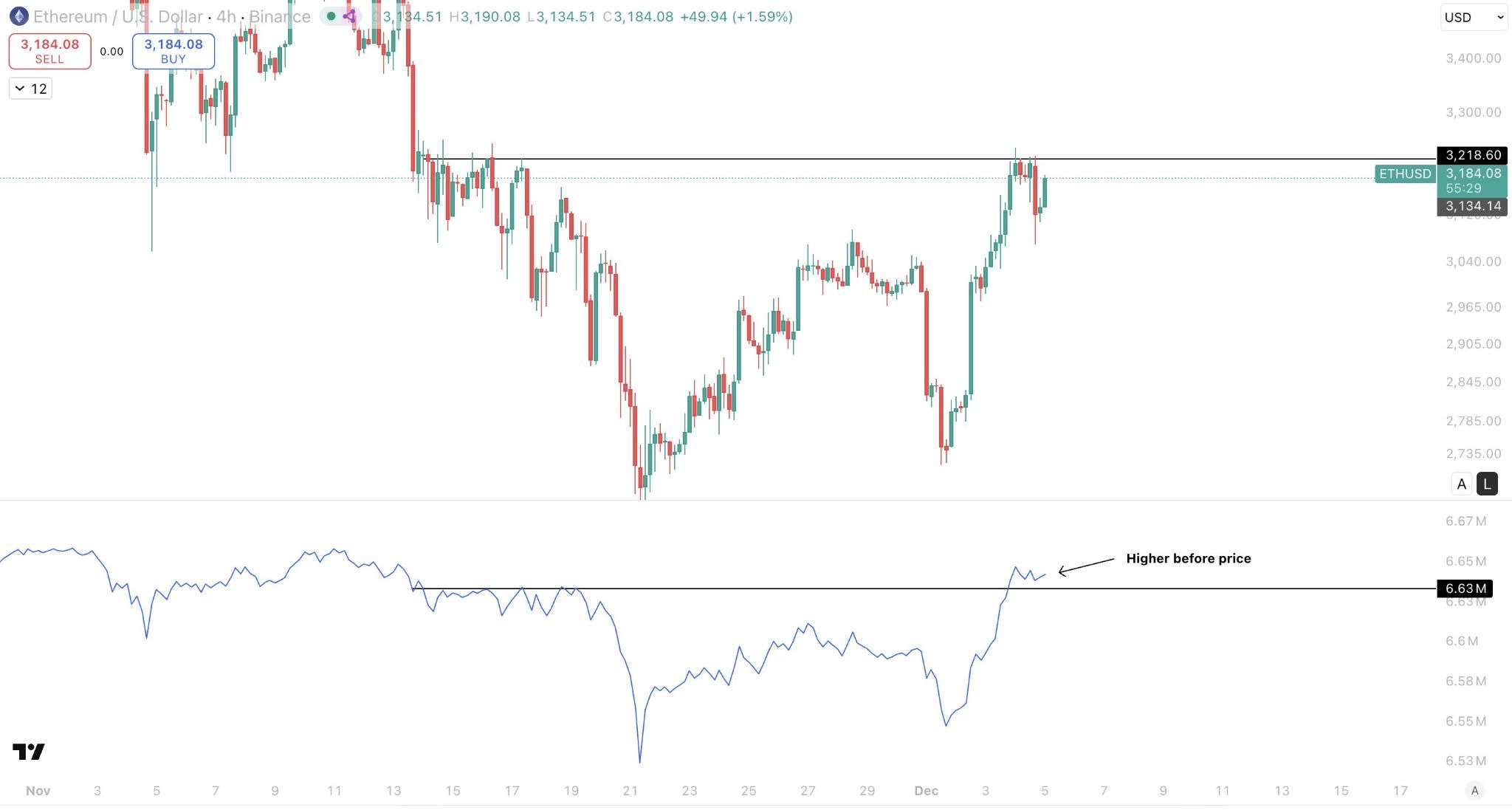
Sykodelic noted that OBV is a reliable leading indicator and that the current setup often precedes upside moves — though nothing is guaranteed.
Price action and market context
Ether has mostly held above $3,000 over recent days, consolidating around $3,050. The market has struggled to clear resistance at $3,200. Meanwhile, the ETH/BTC pair broke above a long-term downtrend line, a technical sign that ETH may be gaining strength relative to Bitcoin.
Despite tight supply, sentiment still looks cautious. Traders are watching macro data and liquidity indicators. If demand returns while exchange balances stay low, a sharper price move upward becomes more likely.
Final Thought
Ethereum’s shrinking exchange supply is a major structural development. With large amounts of ETH tied up in staking, restaking, L2s, DATs, and custody, the market is moving into an unusually tight supply environment. Combined with signs of hidden buying from volume indicators, this setup raises the odds of a supply-driven price rally once demand accelerates. Keep an eye on exchange balances, OBV readings, and the $3,200 resistance level — they will likely tell the next part of the story.