

Bitwise CEO Hunter Horsley Predicts New Market Cycle
Key Takeaways:
• Bitwise CEO Hunter Horsley says the traditional four-year cycle is over, replaced by a new market structure shaped by ETFs and pro-crypto regulation.
• Despite a sharp correction and extreme fear readings, Horsley argues crypto fundamentals are the strongest they’ve ever been.
• The Crypto Fear and Greed Index has plunged to 16 as Bitcoin hits a six-month low near $94,600.
• Analysts see potential downside toward $86,000 amid thin liquidity and cautious rate-cut expectations.
• Horsley believes the market has been in a quiet bear phase for six months and may be nearing a structural turning point.
A Strong Long-Term Setup Despite the Market Rout
The sharp correction across crypto in October and November has dragged prices to multi-month lows and pushed sentiment into “extreme fear.” Yet Bitwise CEO Hunter Horsley argues the opposite of prevailing investor mood: the long-term fundamentals of crypto have never looked stronger.
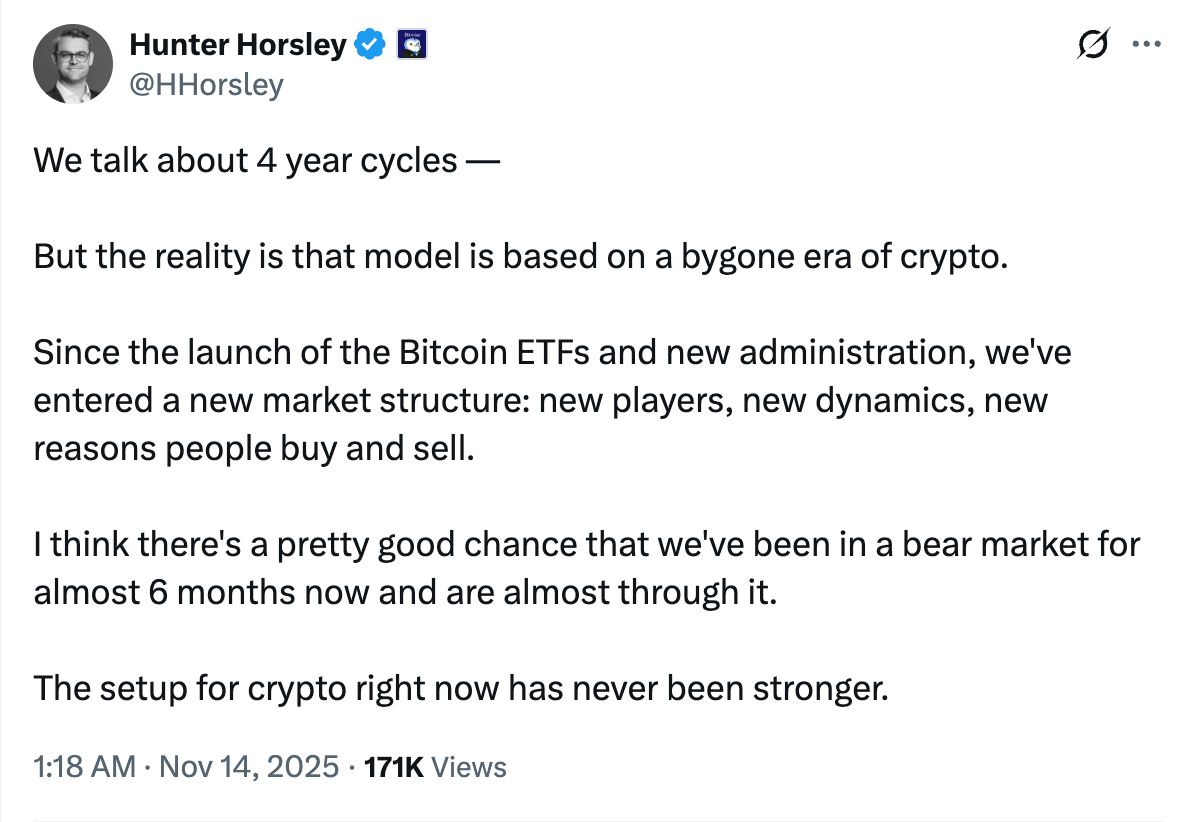
In a post shared on X, Horsley said the historical four-year cycle no longer defines market behavior. Instead, the launch of US spot Bitcoin ETFs and a new pro-crypto regulatory stance have introduced deeper liquidity, new market participants, and a more mature structural foundation. These forces, he said, have reshaped why investors buy and sell, creating market dynamics that differ sharply from past cycles.
Horsley emphasized that the industry may have been in a bear phase for nearly six months and is likely nearing the end of it. Despite the capitulation-like sentiment, he views the current backdrop as one of the strongest setups crypto has seen. His optimism comes at a time when the broader market is dominated by fear, with major assets trading far below their 2024 highs.
Sentiment Hits Extreme Fear as Analysts Gauge the Bottom
The divergence between market psychology and fundamental outlook is stark. The Crypto Fear and Greed Index sits at 16, firmly in “extreme fear,” marking its lowest reading since February. Even though the recent 25% drawdown is milder than previous cycle corrections, many of which exceeded 30%, investors remain deeply pessimistic.
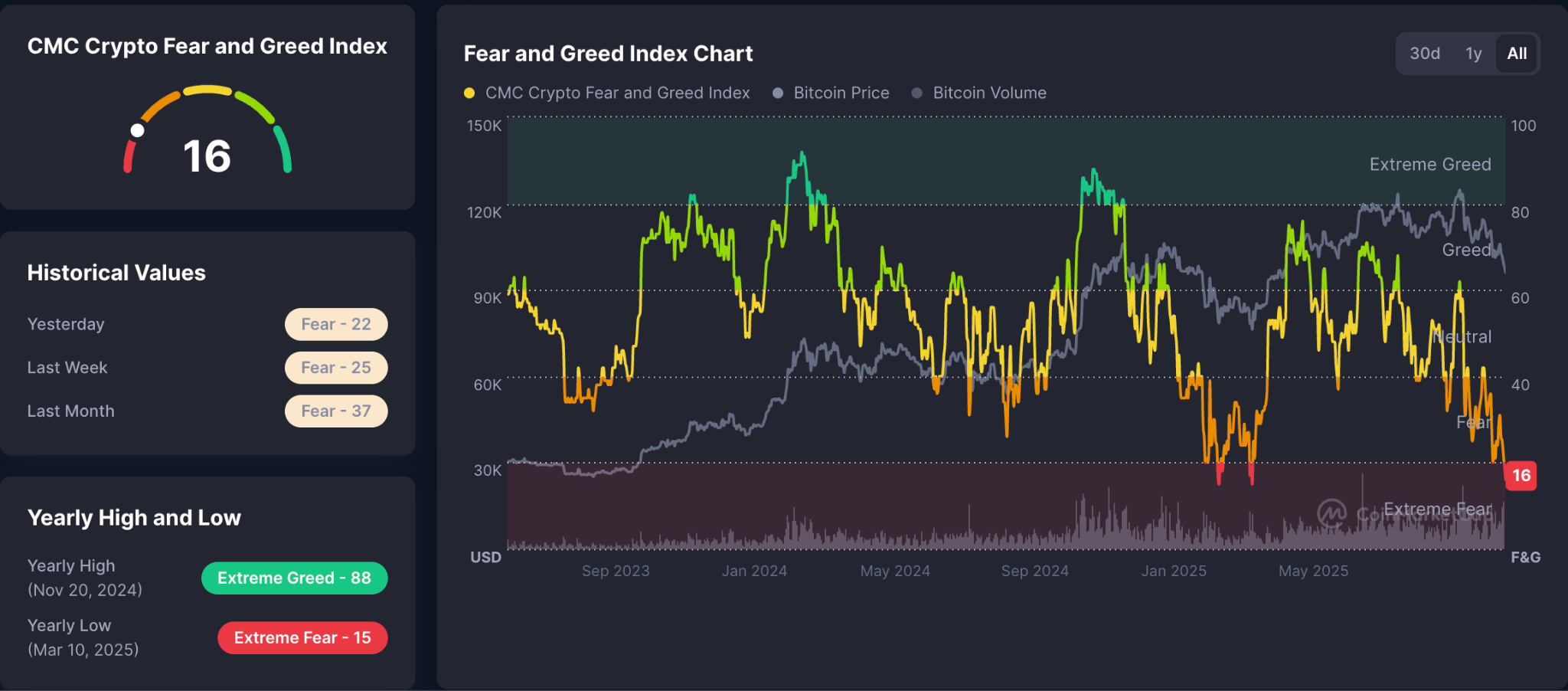
Bitcoin dropped to a six-month low of $94,590, prompting analysts to outline potential downside targets. Some projects Bitcoin could retest the $86,000 level as liquidity thins and risk appetite weakens. Market analyst Nuc Puckrin noted that sentiment has collapsed despite the correction being less severe than historical norms, underscoring the fragile psychological environment.
Adding to the pressure, investor and author Robert Kiyosaki attributed the downturn to strained market liquidity. He argued that sustained price recovery for crypto and precious metals will likely require renewed monetary expansion as the US government faces persistent fiscal deficits. Liquidity, he said, remains the dominant force behind asset valuations.
Although the Federal Reserve has already begun cutting interest rates, expectations for another rate cut in December remain uncertain. CME futures show only 44% of traders pricing in a further reduction, reflecting lingering caution even as policy loosens.
A Market Reshaped by ETFs, Liquidity Cycles, and New Participants
Horsley’s contrarian stance rests on the belief that structural changes since early 2024 have fundamentally altered the crypto landscape. The introduction of spot Bitcoin ETFs has brought in institutional investors with longer time horizons and greater capital depth. Meanwhile, a friendlier regulatory environment is driving more transparent, rules-based participation.
These shifts, he said, break the industry out of its historical boom-and-bust template. Instead of predictable halving-driven cycles, crypto is now influenced by liquidity flows, ETF demand, institutional accumulation, and policy alignment.
For Horsley, the current downturn is part of a transitional phase rather than a systemic collapse. With new investor classes entering the market and regulatory clarity increasing, he believes crypto is positioned for long-term strength once short-term fear fades.
His view contrasts sharply with the current mood, but it suggests a broader narrative: the market may be resetting, not unraveling, and structural forces may soon outweigh sentiment-driven volatility.