

French Banking Giant BPCE to Launch In-App Crypto Trading for Millions of Users
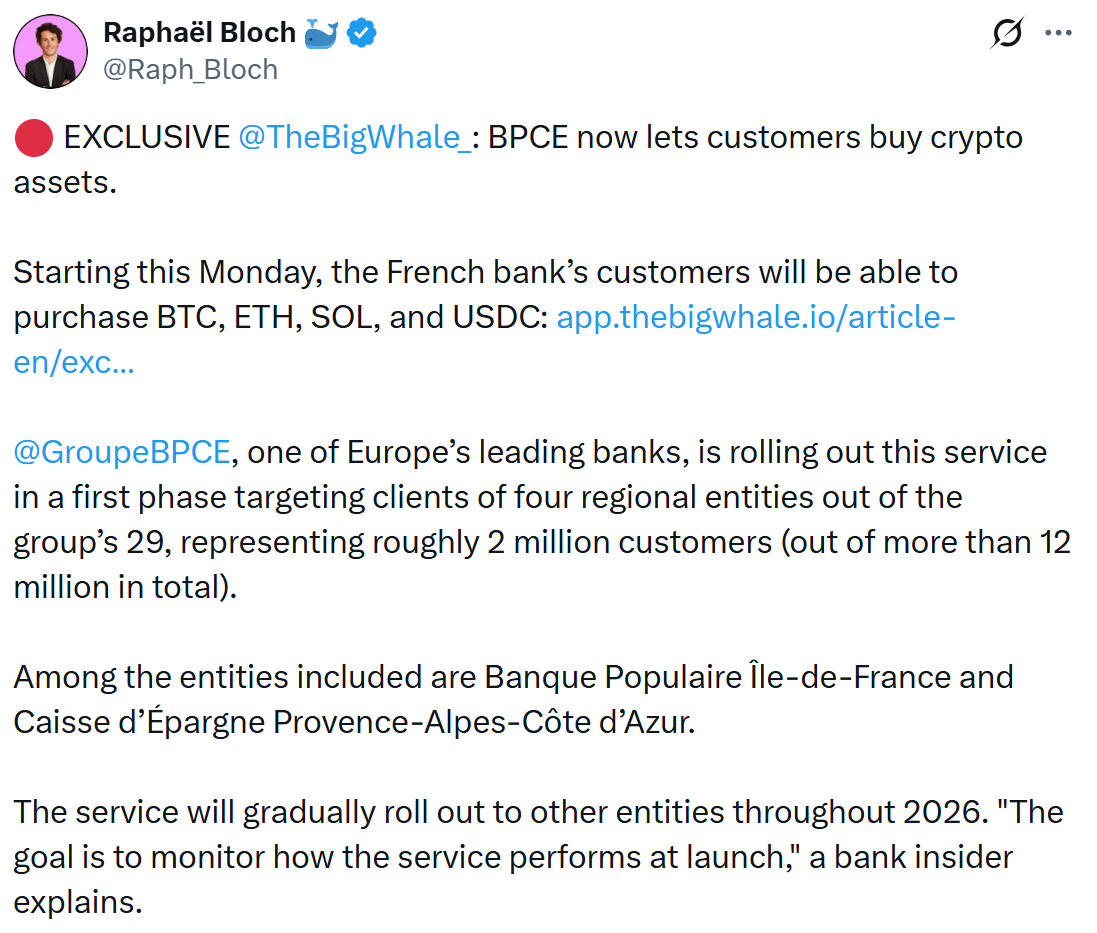
- BPCE will allow customers to trade BTC, ETH, SOL and USDC directly inside banking apps starting Monday.
- Initial rollout covers 2 million customers across four regional banks, expanding to 12 million users by 2026.
- Crypto services will operate through a paid digital asset account managed by Hexarq, BPCE’s crypto subsidiary.
- Monthly fee: €2.99; trading commission: 1.5% per transaction.
- Move positions BPCE against Europe’s crypto-friendly fintechs like Revolut and Bitpanda.
- France is simultaneously exploring a new wealth tax that includes crypto holdings.
BPCE becomes one of Europe’s first major banks to offer native crypto trading
French financial giant BPCE — the country’s second-largest banking group — is preparing to bring crypto trading directly into the banking experience for millions of retail clients. According to reporting from The Big Whale, BPCE will enable users to buy and sell Bitcoin, Ether, Solana and USDC inside the Banque Populaire and Caisse d’Épargne mobile apps.
This marks one of the most significant moves by a traditional European bank into retail-facing crypto services. For years, customers have relied on crypto-native exchanges or fintech platforms; BPCE’s integration brings digital assets straight into the mainstream financial environment.
The launch begins Monday for clients of four regional banks — including Banque Populaire Île-de-France and Caisse d’Épargne Provence-Alpes-Côte d’Azur. BPCE expects this pilot phase to reach around 2 million customers.
An internal source explained that the group is intentionally pacing the rollout, monitoring user adoption, security, and operational stability before expanding further. By 2026, the bank plans to enable crypto trading across all 25 regional entities, covering its entire 12 million-customer retail network.
Paid in-app crypto accounts managed by BPCE’s Hexarq
Crypto functionality will be provided through a dedicated digital asset account integrated into the existing banking apps. This feature will be operated by Hexarq, BPCE’s in-house crypto subsidiary, ensuring that custody, compliance, and execution remain within the group’s controlled infrastructure.
Pricing and trading fees
- Monthly account fee: €2.99
- Trading commission: 1.5% per transaction
- Minimum fee: $1.16
The setup allows customers to buy and sell crypto without relying on external exchanges or third-party wallets, a major differentiator from most European banking apps.
BPCE’s move also signals intensifying competition with fintech challengers like Revolut, Deblock, Bitstack, and Trade Republic, all of which have been capturing younger, crypto-active users through simplified trading tools.
BPCE is not alone.
- BBVA already offers Bitcoin and Ether trading — plus custody — for Spanish customers.
- Santander’s Openbank provides access to five cryptocurrencies.
- Raiffeisen Bank partnered with Bitpanda to deliver crypto services in Austria.
Traditional institutions are clearly shifting toward direct digital asset integration as customer demand climbs.
France signals tougher stance on crypto with new wealth tax proposal
France may soon classify certain digital assets as part of its “unproductive wealth” category, following a closely contested amendment passed last month. The proposed law would extend the country’s wealth tax to include crypto holdings, luxury assets, and specific real estate.
What the proposed tax includes
- Applies to individuals holding more than $2.3 million in considered “unproductive wealth.”
- Imposes a flat 1% tax, replacing the current progressive real estate tax.
- Includes digital assets such as cryptocurrencies in the taxable base.
The measure must still pass the Senate as part of the 2026 budget process. If approved, high-net-worth crypto holders in France could see significantly higher tax obligations.
Final Thought
BPCE’s decision to introduce in-app crypto trading for up to 12 million customers marks one of the strongest signals yet that traditional European banking is embracing digital assets. While fintech competition and rising consumer demand push banks toward integration, upcoming tax reforms in France could complicate the landscape. Still, combining regulated banking infrastructure with seamless crypto access may accelerate mainstream adoption more than any European initiative to date.