
China Accuses US of Involvement in $14.5B Bitcoin Hack Linked to LuBian Mining Pool
- China’s cyber agency claims the US gained control of over 127,000 stolen Bitcoin
- The funds, worth $14.5 billion, came from the LuBian mining pool hack in 2020
- US Department of Justice (DOJ) filed the largest forfeiture case in its history
- China questions how the US obtained access to the hacked Bitcoin
- Evidence suggests the US had control of the funds for over a year before the case was filed
China’s top cybersecurity agency has raised serious concerns about the alleged role of the United States in one of the largest Bitcoin hacks ever recorded. The Chinese National Computer Virus Emergency Response Center (CVERC) released a report accusing the US of controlling billions in stolen Bitcoin tied to the LuBian mining pool hack.
The incident traces back to December 2020, when LuBian, a once-prominent Chinese Bitcoin mining pool, was hacked, losing 127,272 BTC — worth roughly $14.5 billion today. The case stayed largely hidden until August 2024, when analytics firm Arkham identified it as the largest Bitcoin hack in history.
Weeks later, the US Department of Justice (DOJ) filed a civil forfeiture complaint seeking to seize 127,271 BTC connected to Chen Zhi, the founder of the Prince Group, who reportedly owned LuBian’s Bitcoin at the time of the hack. The DOJ described the filing as the largest forfeiture action in the agency’s history.
However, according to the CVERC report, the US already had control over the funds before the official filing. The indictment noted that “those funds are presently in the custody of the US government,” suggesting they were already seized. Data from Arkham appears to confirm this, showing that on July 5, 2024, nearly 120,576 BTC was transferred from an address labeled “LuBian.com Hacker” to one marked “US Government: Chen Zhi Seized Funds.”
This raised immediate questions from Chinese authorities about how the US gained access to the hacked Bitcoin. The CVERC stated that the stolen funds had been dormant for nearly four years, with no movement since the 2020 hack, until the massive transfer in 2024. The report argued that this behavior is “clearly inconsistent with the nature of ordinary hackers,” who typically move funds quickly to cash out or launder them.
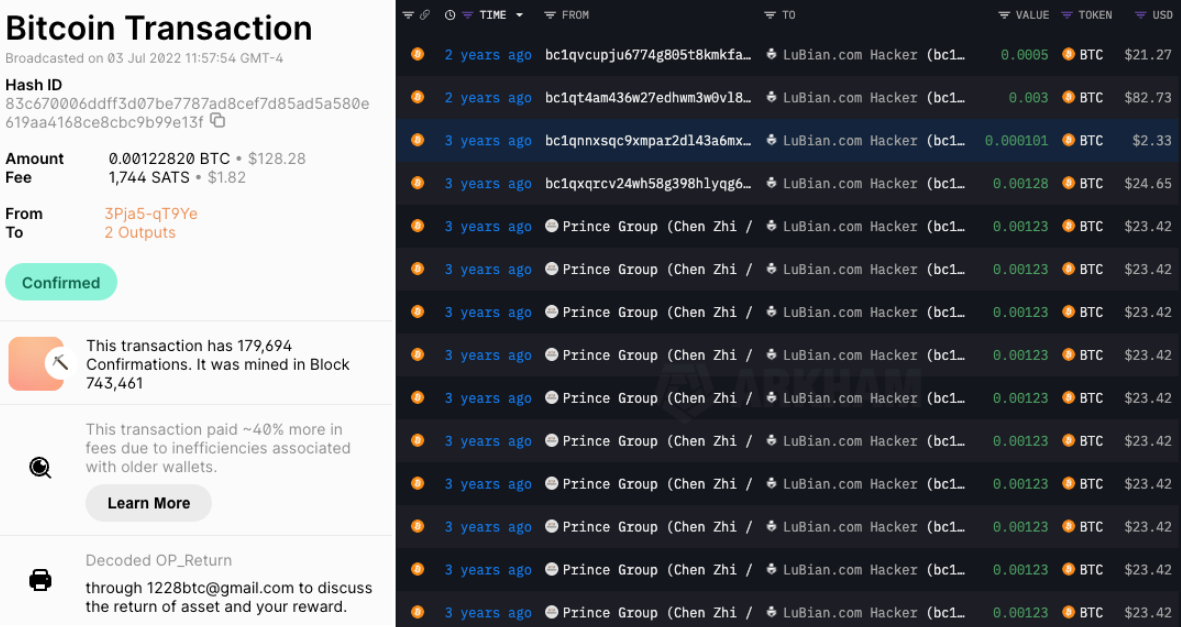
CVERC suggested that the entire operation might have been orchestrated by a state-backed entity, rather than independent hackers. To support this, the report cited on-chain messages sent by Chen Zhi and the Prince Group, who tried to contact the hacker multiple times via Bitcoin transactions worth around $23 each, offering rewards for the return of the stolen funds. The hacker never responded.
The revelations add a geopolitical twist to an already complex crypto case. If the allegations hold weight, it would mean the US government took possession of stolen Chinese Bitcoin long before public legal proceedings began — a claim that could strain relations further between the two nations.
According to Arkham’s latest data, the LuBian-related Bitcoin represents roughly 39% of all 326.5 BTC (worth $34.2 billion) currently held in wallets linked to the US government.
Interestingly, the controversy emerged just after Donald Trump declared that the US is “far ahead of China” in cryptocurrency adoption, highlighting how crypto and geopolitics are increasingly becoming intertwined.
Final Thought:
The LuBian Bitcoin hack may no longer be just a story of cybercrime — it’s turning into a geopolitical power play between two global rivals. With China questioning how the US obtained control of the stolen Bitcoin, the case could escalate beyond blockchain forensics into international diplomacy.