

Coinbase to Reincorporate in Texas, Citing Favorable Legal and Regulatory Climate
- Coinbase will move its incorporation from Delaware to Texas, highlighting differences in legal predictability between the two states
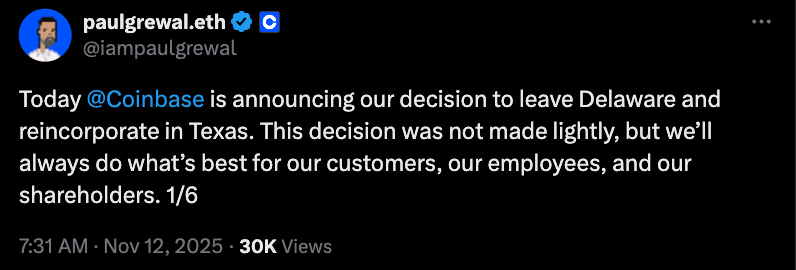
- Chief Legal Officer Paul Grewal cited Texas’s “efficiency and predictability” as key reasons for the move
- Decision follows Coinbase’s remote-first policy with existing offices in San Francisco and New York
- Texas Blockchain Council and state officials hailed the move as proof of Texas’ crypto-friendly environment
- Texas continues to grow as a major U.S. crypto and blockchain hub, home to leading miners and tech firms
Coinbase, the largest U.S.-based cryptocurrency exchange, has announced that it will reincorporate from Delaware to Texas, signaling a major shift influenced by each state’s distinct legal and regulatory climates.
The move, revealed by Coinbase Chief Legal Officer Paul Grewal on Wednesday, underscores the exchange’s search for greater legal stability and efficiency. Grewal wrote in a Wall Street Journal op-ed that Delaware’s legal system had become “rife with unpredictable outcomes,” while Texas offers a more business-friendly and predictable environment.
“This decision was not made lightly, but we’ll always do what’s best for our customers, our employees, and our shareholders,” Grewal stated in his post on X.
Coinbase’s Remote-First Operations
Since 2021, Coinbase has operated under a “remote-first” policy, closing its San Francisco headquarters following the easing of COVID-19 restrictions.
Although it maintains offices in San Francisco and New York, the company had remained incorporated in Delaware — until now.
The decision to shift incorporation comes amid Coinbase’s broader push to expand its U.S. footprint, even as regulatory clarity for digital assets remains a work in progress.
Coinbase CEO Brian Armstrong recently revealed that the company plans to hire around 1,000 people in the U.S., signaling renewed confidence in the country’s evolving crypto regulatory landscape. Armstrong, a frequent presence in Washington, D.C., continues to lobby for a clear market structure bill and has participated in multiple White House crypto discussions.
Texas: A Growing Crypto and Blockchain Hub
Texas officials and blockchain advocates welcomed Coinbase’s move as another milestone in the state’s transformation into a national crypto powerhouse.
Lee Bratcher, president of the Texas Blockchain Council, told Cointelegraph:
“We are thrilled that Coinbase is redomiciling and reincorporating in Texas. Texas has been the epicenter for company relocations in the U.S. for decades due to our business-friendly climate. We now have a digital assets-friendly regulatory environment as well.”
The Lone Star State already hosts major crypto mining companies such as Riot Platforms, MARA Holdings, and Bitdeer, as well as Big Tech firms like Meta and Google with offices in Austin, the state’s capital.
While Coinbase does not currently plan to open a physical office in Texas, the state’s pro-business laws and favorable regulatory stance on digital assets made it an attractive choice for incorporation.
State Support and Industry Significance
Texas lawmakers have long positioned the state as a leader in blockchain innovation.
Texas Senator Charles Schwertner, one of the original sponsors of a bill proposing a state Bitcoin reserve, celebrated Coinbase’s decision:
“Coinbase’s relocation reinforces Texas as a hub for innovation and underscores our commitment to remaining the nation’s premier destination for business.”
This move not only strengthens Texas’s status as a national crypto hub, but also reflects a broader industry trend — where major blockchain firms are gravitating toward states offering regulatory clarity and judicial consistency.
Coinbase’s decision to shift its incorporation from Delaware to Texas marks a symbolic and strategic move in favor of legal predictability and pro-innovation governance. As the crypto industry continues to navigate complex U.S. regulations, Texas’s growing reputation as a blockchain-friendly state could attract even more companies looking for both regulatory stability and growth opportunities.