


Crypto Market Weekly Recap: Fed Cut, Trade Deals, and AI Shifts
This Crypto Market Weekly Recap covers a volatile week marked by the Fed’s rate cut, renewed US–China trade optimism, and AI-driven layoffs. Despite sharp swings, institutional inflows and stablecoin resilience signaled a market finding its balance after the storm.
A Week of Fed Uncertainty and Trade Optimism Amid Declines
Between October 27 and November 3, 2025, the cryptocurrency market moved through a tense and uneven stretch marked by policy shifts, global trade developments, and cooling investor confidence. The Federal Reserve’s 0.25% rate cut to 3.75–4% offered a brief lift in sentiment before Chair Jerome Powell’s hawkish remarks reminded investors that inflation remains unresolved. At the same time, progress in US–China trade talks helped ease global tensions, yet monetary caution dominated the week’s tone. Total crypto market capitalization slipped from $3.9 trillion to $3.61 trillion, a weekly decline of 7.4%.
Bitcoin ended at $107,766, down 6.5% for the week. Ethereum dropped 8.2% to $3,731, while Solana fell to $177 and XRP to $2.43, losing 7.9% and 5.6% respectively. BNB showed relative strength, easing 2.3% to $1,125 on steady network expansion. Daily trading volume averaged $127.47 billion, a 12% decrease from the previous week, reflecting a quieter but cautious market. The CoinMarketCap Fear and Greed Index dropped from 42 to 36, signaling defensive sentiment as investors weighed mixed macro signals.
The Fed’s decision ended its tightening cycle but left uncertainty over the next move. In trade, Washington and Beijing paused tariff escalations and reopened agricultural channels, signaling a cooperative shift after months of strain. Meanwhile, the labor market felt the effects of AI-driven restructuring. Amazon announced 30,000 job cuts, and Chegg trimmed nearly half its workforce, reflecting a broader transition toward automation and efficiency.
Within crypto, stablecoins stood out as the most stable segment of the market. IBM introduced its Digital Asset Haven initiative, Citi strengthened its partnership with Coinbase, and Western Union accelerated its digital transformation. Japan’s Financial Services Agency approved JPYC’s registration as a licensed stablecoin, further legitimizing the sector. Larry Fink at BlackRock reaffirmed Bitcoin and gold as preferred inflation hedges, while MicroStrategy held firm on its long-term position with 640,808 BTC under management.
On-chain data showed that liquidity remained intact despite price weakness. Stablecoin supply stayed near $300 billion, exchange inflows declined as forced selling eased, and DeFi total value locked steady around $42 billion. The broader market was cooling, not collapsing — consolidating ahead of clearer macro direction.
Three narratives stood out over the week. AI’s growing disruption of traditional employment dominated global headlines. Stablecoins continued to move deeper into mainstream finance, connecting banks, payment firms, and retail systems. The “all-in” risk culture that once fueled speculative manias gave way to a more selective, measured investment mindset.
Geopolitical momentum added some optimism. A new US–Vietnam trade framework reduced tariffs on electronics and textiles, while additional deals with Cambodia, Malaysia, and Thailand expanded coverage to nearly 70% of Southeast Asia’s trade, with a focus on rare earths and agriculture. These agreements reinforced regional supply chain resilience and opened space for digital finance adoption across the region.
Despite high expectations for “Uptober,” Bitcoin closed October down 5%, its weakest performance since 2015. Analysts from FxPro and Crypto.news still expect recovery toward $130,000 if the Fed clarifies its policy stance and trade conditions continue improving. With $3.2 billion in token unlocks ahead, short-term volatility may return, yet inflows from institutions and stable liquidity offer solid support for the market’s next phase.
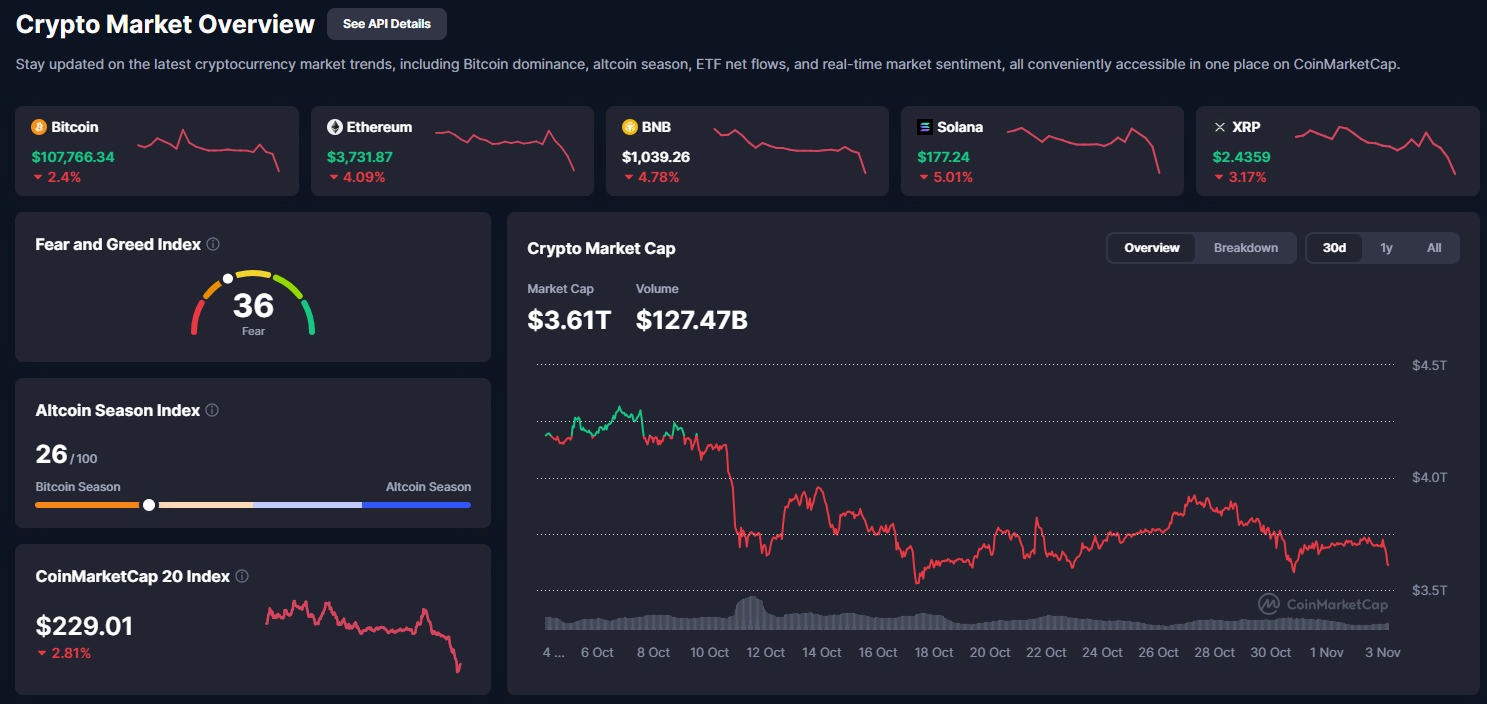
From the CoinMarketCap overview (Image 1: Crypto Market Overview dashboard displaying total cap at $3.61T, volume $127.47B, Fear & Greed at 36, Altcoin Season Index at 26, and CoinMarketCap 20 Index at $229.01 -2.81%), the decline is evident: cap line trends downward from late-October levels, with volume spikes on sell-offs.
Analysis of Crypto Total Market Cap and Indices
The CoinMarketCap dashboard this week reflected a market caught between caution and quiet resilience. Total capitalization reached $3.61 trillion, a modest 0.34% daily gain that failed to offset losses from the recent decline. The drop from $3.9 trillion earlier in October erased most of the month’s progress, signaling that traders were still wary after the Fed’s mixed signals. Daily trading volume averaged $127.47 billion, down 12%, suggesting that participants were waiting rather than fleeing. Bitcoin held firm with a 57.5% market share, while altcoins collectively occupied 42.5%, a sign that investors were leaning toward safety.
Looking at the 30-day chart, the market has been sliding gradually since mid-October, testing the 50-day moving average near $3.65 trillion. The movement echoed similar consolidation patterns last seen in 2022. October’s usual strength, which historically averages a 28% increase, never arrived this year. Volume data showed consistent selling pressure, with Ethereum’s share shrinking to 17%, Solana’s to around 3%, and XRP hovering close to 1.2%. The Fed’s cautious tone continued to limit risk appetite, though optimism surrounding global trade helped cushion the market from deeper losses.
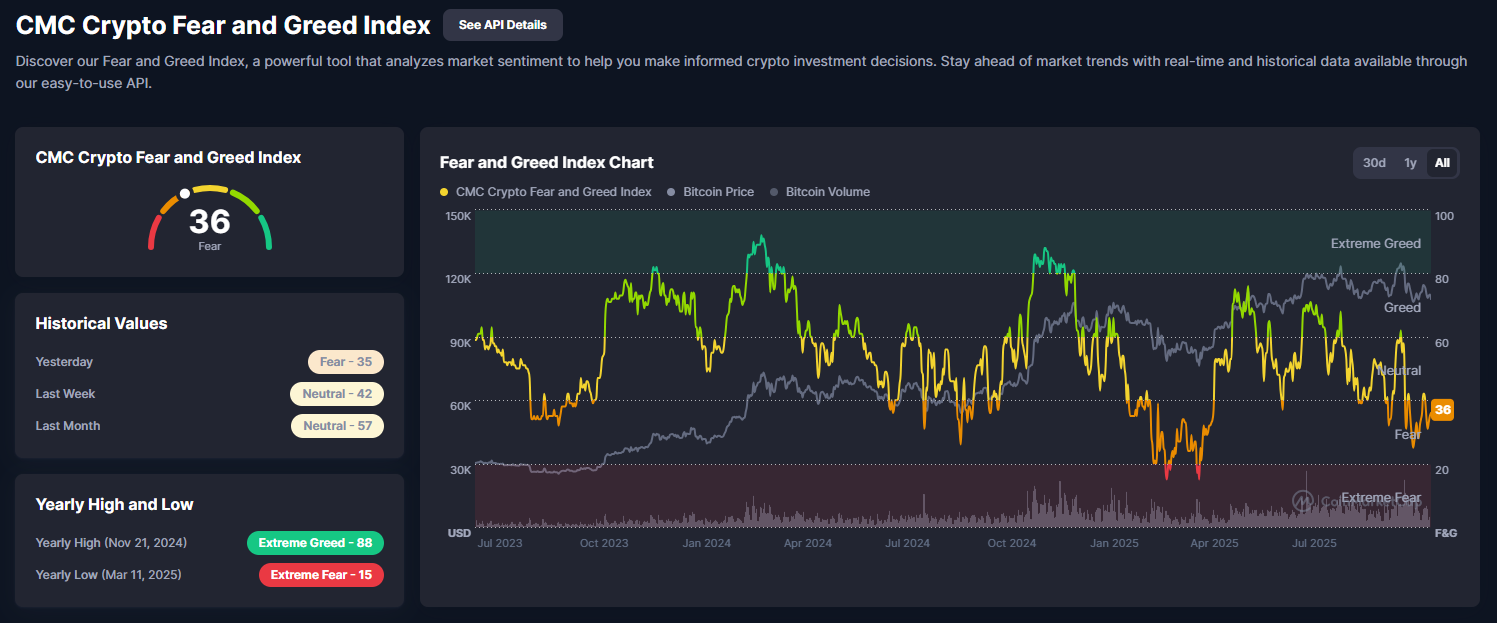
Investor sentiment followed that same hesitant rhythm. The CoinMarketCap Fear and Greed Index registered at 36, firmly in the “Fear” zone. Yesterday’s reading was 35, last week’s 42, and last month’s 57, charting a clear slide in confidence. The index’s yearly range between 15 and 88 suggests the current level sits within a potential accumulation window. Volatility jumped 15%, social activity fell 10%, and traders shifted their focus toward short-term opportunities. Historically, fear readings at these levels have often marked turning points, with strong recoveries once stability returned.
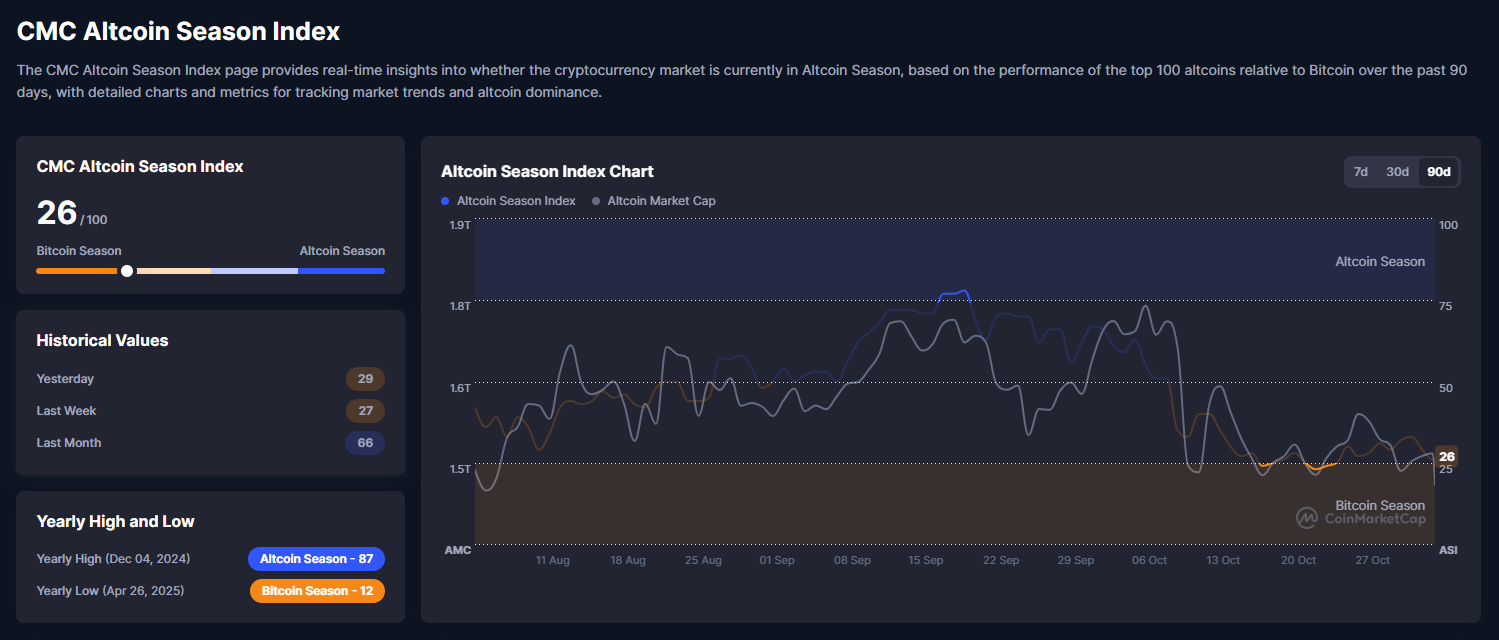
Bitcoin’s dominance shaped the narrative across the board. The Altcoin Season Index, now at 26 out of 100, confirmed a strong tilt toward Bitcoin-led performance. The index has declined steadily from 29 a day earlier and 66 a month ago, showing how capital continues to rotate out of smaller tokens and into the relative security of BTC. Historically, similar levels have appeared near market inflection points, when altcoins start to regain traction after a consolidation phase. The current data suggests that capital is not leaving the market but repositioning, waiting for clarity before risk appetite returns.
Technical Analysis and Outlook for Key Tokens
As of November 3, 2025, the crypto market sits at a critical crossroads, shaped by technical signals, fundamental shifts, and global macro currents. Charts across major assets reveal a market searching for balance after a volatile month driven by the Fed’s mixed policy stance and uneven risk sentiment. The Fear and Greed Index at 36 reflects the nervous tone that now defines trading behavior, while an Altcoin Season Index of 26 confirms Bitcoin’s hold over the market cycle.
Bitcoin continues to act as the anchor for overall sentiment. Price action shows a market respecting support zones but hesitant to chase momentum. The structure remains intact, though resistance layers are firming near recent highs. Ethereum trades in a more reactive rhythm, its chart still within an ascending pattern but sensitive to macro news and ETF flows. Solana maintains technical strength with higher lows despite recent pressure, while XRP consolidates in a narrow range as traders await confirmation of broader risk appetite.
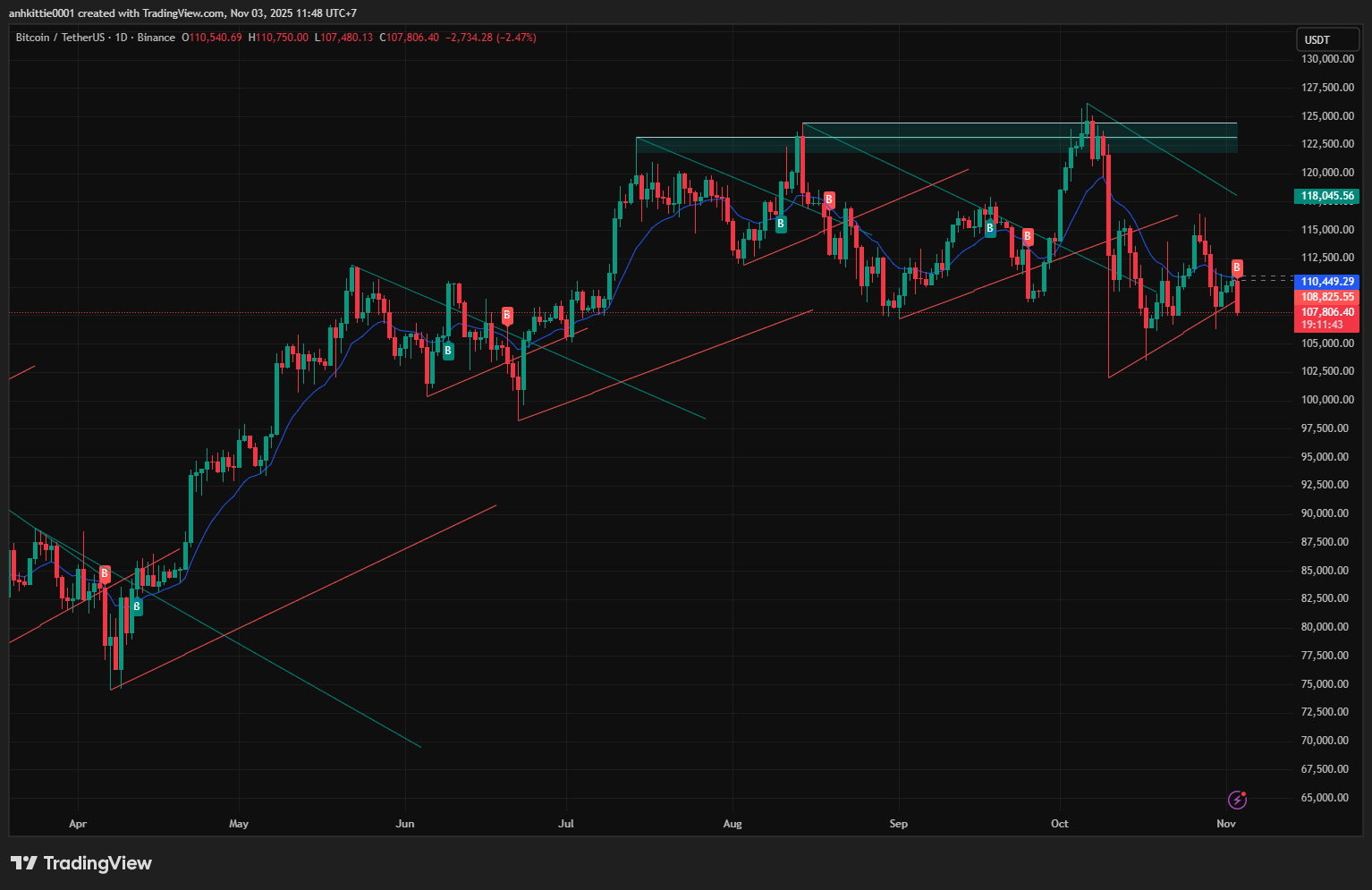
For Bitcoin (BTC/USDT on Binance, Image 4: Daily chart showing price at $107,766.34 -2.4%, in ascending channel from February 2025 lows)
Technical: Bullish structure remains intact. Support at $104,000 held firm during the recent dip, with higher lows forming from $96,000. The 50-day MA near $110,000 acts as key resistance. A descending wedge pattern post-tariff shows converging lines, suggesting a potential breakout. Buy signals appear around $106,000 on rebounds, while profit-taking zones sit near local peaks. Volume has lightened but stabilized. RSI at 46 signals mild oversold conditions with divergence forming. Bollinger Bands continue to contract, hinting at an upcoming volatility burst similar to 2021’s 30% expansion phases. MACD stays negative but momentum is fading.
Fundamental: ETF outflows reached $470.7M, though long-term holders retained 73% of supply. Mining activity increased fourfold compared to average rates. Corporate interest stayed strong, led by Metaplanet’s $632M BTC addition.
Macroeconomic: The Fed’s hawkish tone after the 0.25% rate cut kept markets cautious. Bitcoin fell 6.5% on the week but benefited from improving trade sentiment and a weaker DXY. Gold at $3,941 continued to serve as a hedge reference.
Scenarios:
• Uptrend: Break above $110,000 opens targets at $114,000–$118,000, aligning with historical +35% post-Fed rallies (NUPL 0.5).
• Downtrend: Drop below $104,000 exposes $100,000, with ~$39B in open interest at risk of liquidation.
• Sideways: Consolidation between $104,000–$110,000, range fluctuation around ±6%.
• High Volatility: Reaction to Fed or trade headlines may widen swings to ±10%.
• Bias: Neutral, with MVRV at 2.5, showing Bitcoin remains fairly valued.
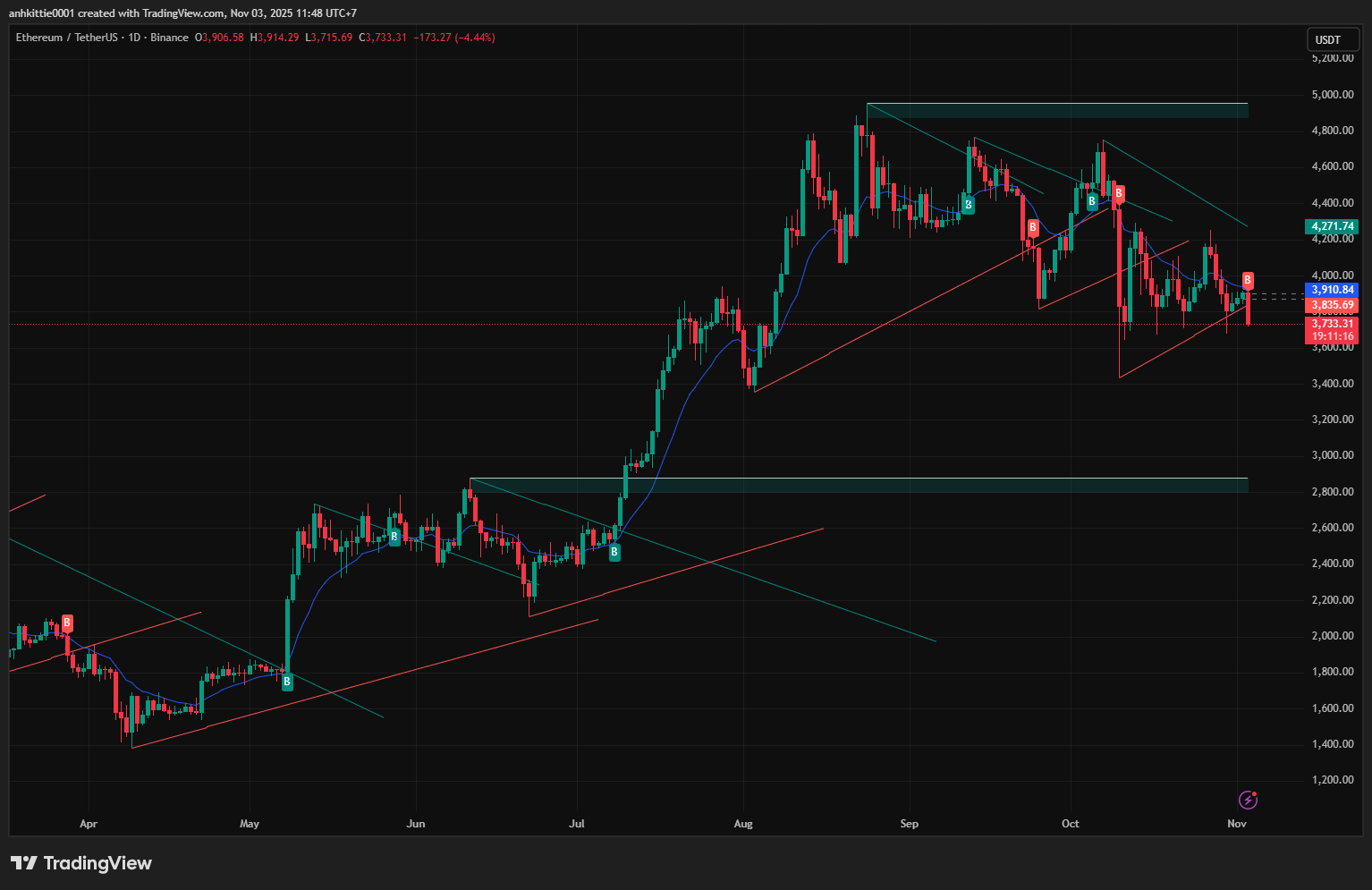
Ethereum (ETH/USDT on Binance, Image 5: Daily chart at $3,731.87 -4.09%, uptrend channel with triangle).
Technical: The trendline around $3,600 continues to hold, with the 50-day MA near $3,800 acting as short-term support. A falling wedge is forming, creating a potential buy zone around $3,700 and a sell area near recent highs. Volume spiked during the drop but has since flattened. RSI at 42 shows oversold conditions without clear divergence. The MACD histogram remains negative but is beginning to turn upward. Bollinger Bands are tightening, suggesting a potential squeeze similar to 2021’s 35% post-compression breakout.
Fundamental: ETF outflows totaled $184.2M, while staking supply reached 29.5M ETH. The upcoming Fusaka upgrade in December is drawing attention as a potential catalyst. DeFi TVL stabilized around $42B, signaling confidence in network activity.
Macroeconomic: The Fed’s hawkish stance weighed on risk assets, with ETH down 8.2% weekly, though improving trade conditions and modest Chinese stimulus helped limit further downside.
Scenarios:
• Uptrend: Break above $3,800 could target $4,000–$4,200, with ETH/BTC range at 0.035–0.08 (~$9K).
• Downtrend: Move below $3,700 may open a decline toward $3,500, volatility near 60%.
• Sideways: Consolidation between $3,700–$3,800 as traders wait for macro clarity.
• High Volatility: Price swings up to ±8% driven by Fed or trade reactions.
• Bias: Bullish, supported by strong utility and network fundamentals.
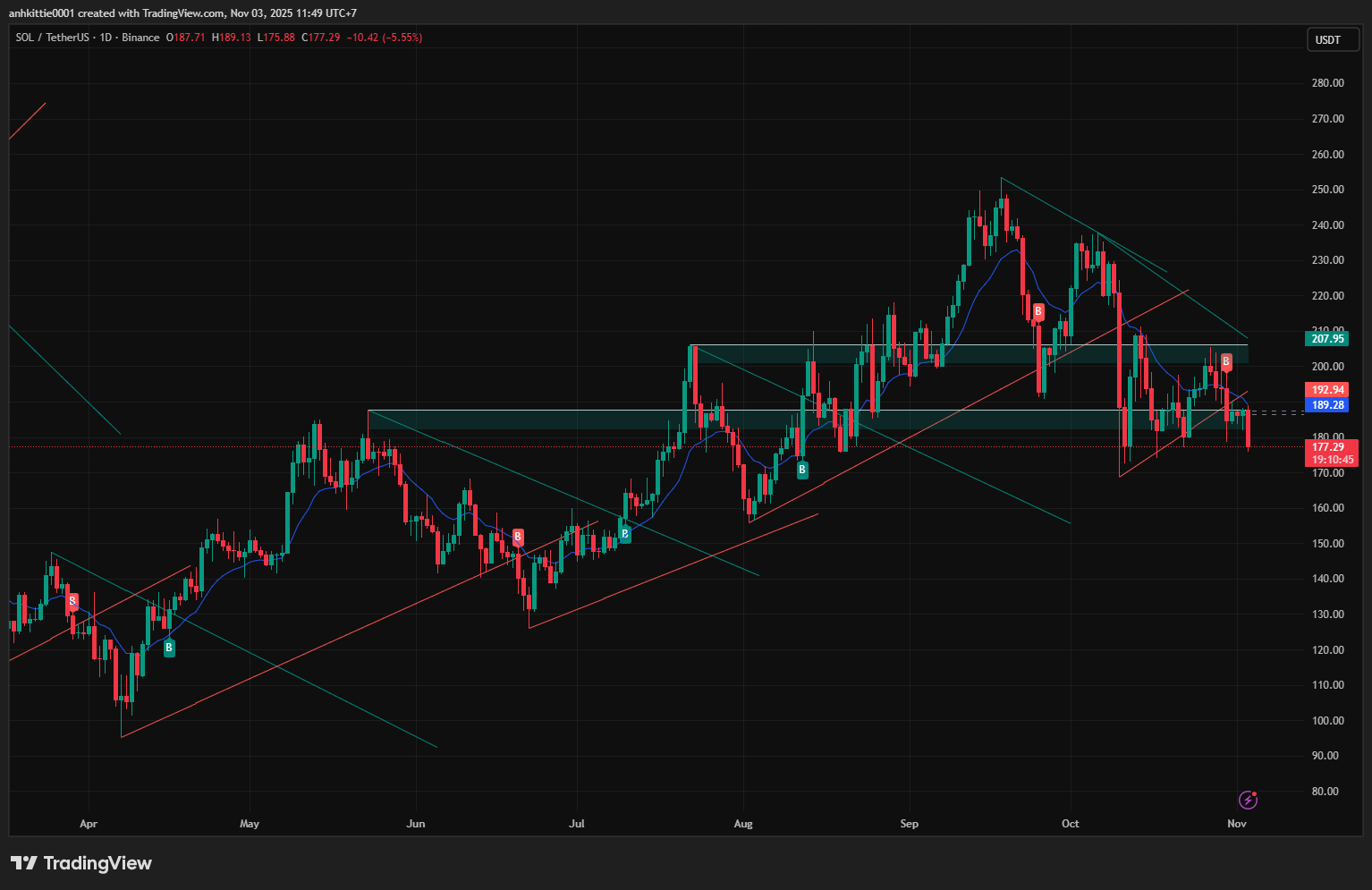
Solana (SOL/USDT on Binance, Image 6: Daily chart at $177.24 -5.01%, rising channel since March).
Technical: Key support at $170 held firm through the latest dip, while higher highs remain intact. A bull flag pattern has formed following the post-crash recovery, with potential buy zones around recent lows. RSI at 45 reflects neutral momentum, and MACD stays negative but stable. Bollinger Bands have widened, indicating room for volatility expansion. Trading volume remains flat but shows early signs of recovery.
Fundamental: Project Alpenglow announced a 40% cost reduction, strengthening sustainability. DeFi TVL sits at $13B, down 5% but stabilizing, while the user base surpassed 1 million. Ecosystem growth continues, led by the upcoming Evo stablecoin launch.
Macroeconomic: Market reactions to the tariff-driven -7.9% correction were softened by Fed easing, which provided a modest lift for DeFi-related tokens. The impact of China’s stimulus remained limited but supportive.
Scenarios:
• Uptrend: Break above $180 could push targets to $190–$200, reflecting a 150% historical expansion seen in 2021.
• Downtrend: Fall below $170 may extend to $160, with volatility near ±10%, particularly in meme-driven segments.
• Sideways: Consolidation expected between $170–$180, tracking Bitcoin’s broader movement.
• Bias: Bullish, supported by strong ecosystem metrics and sustained user growth.
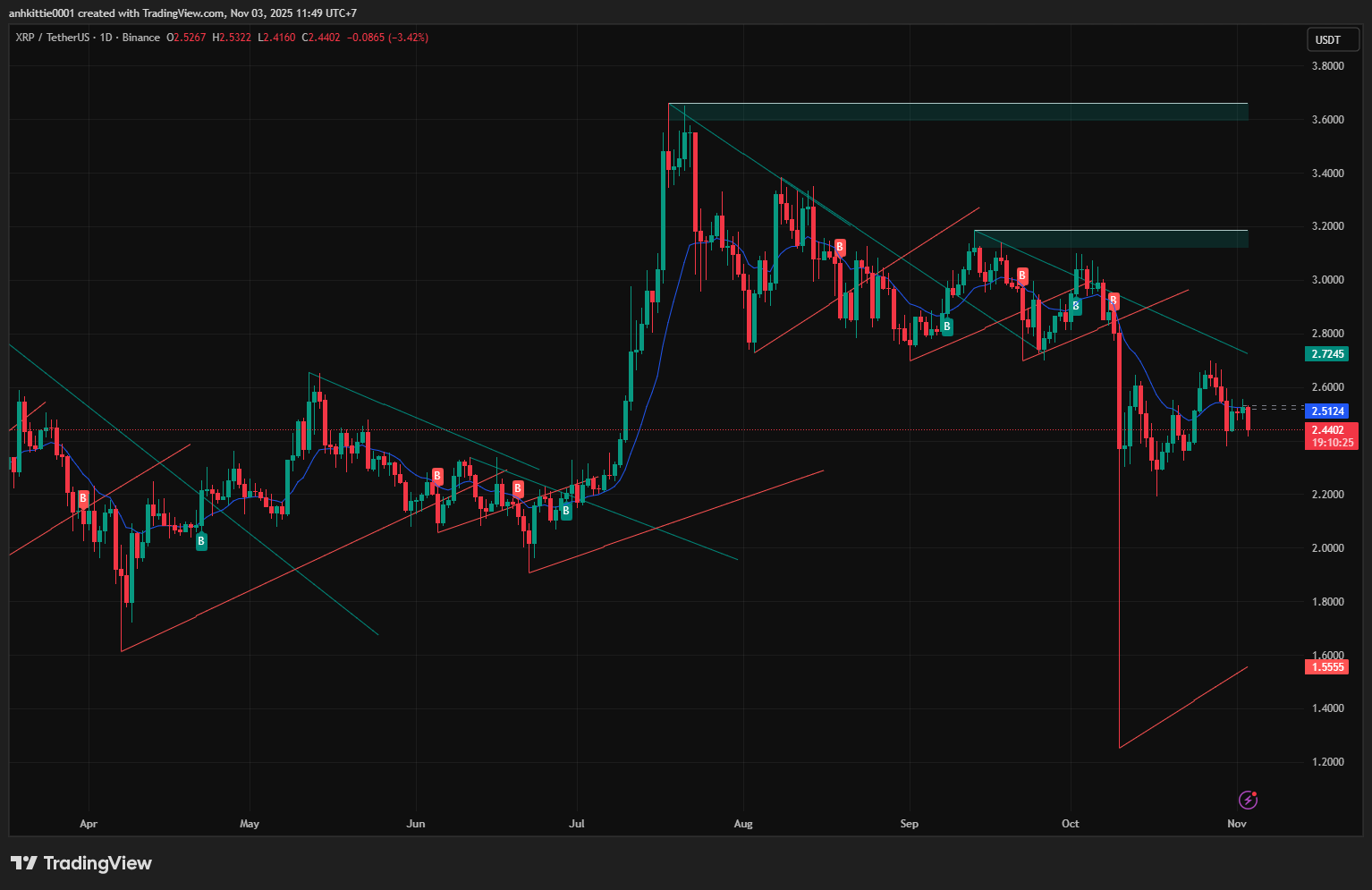
XRP (XRP/USDT on Binance, Image 7: Daily chart at $2.4359 -3.17%, descending triangle).
Technical: XRP traded within a $2.30–$2.50 range, capped by a descending red trendline. The buy zone sits around $2.30, where buyers have consistently stepped in during pullbacks. RSI at 43 shows neutral-to-oversold conditions, while volume remains light but poised for a breakout. Bollinger Bands are tightening, often a precursor to larger price swings — the last similar setup in 2021 led to a 50% move.
Fundamental: Network fundamentals remain solid. SWIFT’s $5T pilot program continues testing cross-border settlement efficiency, and Ripple’s on-demand liquidity (ODL) transactions hold steady at $1.3B, maintaining real-world utility and transaction volume strength.
Macroeconomic: Broader market sentiment was affected by tariff-driven cross-border frictions (-5.6%), but Fed easing in payment systems supported digital settlement narratives, indirectly benefiting XRP.
Scenarios:
• Uptrend: Break above $2.50 could open a path toward $2.70–$2.90, especially if ETF news fuels liquidity inflows.
• Downtrend: Drop below $2.30 may lead to a retest near $2.10 support.
• Sideways: Likely rangebound movement with low volatility until new catalysts emerge.
• Bias: Neutral, with focus on volume confirmation for the next decisive move.
Summary: Technical structure, stable fundamentals, and easing macro conditions together form a base for recovery once market confidence strengthens.
Institutional Inflows: Stabilizing Force in Turbulence
Institutions played a pivotal role in cushioning the tariff blow, injecting $720 million net inflows—the fourth positive week—despite the $20B liquidation storm. BlackRock's IBIT led with $420M BTC, ETHA $300M, pushing ETF revenue to $260M annualized. Fidelity/Grayscale contributed, with Bitwise noting 3.5x mining buys amid outflows. Metaplanet's $632M BTC expansion exemplified corporate dips buying. On-chain ETF holdings hit 520K BTC, up 5% crash notwithstanding. Vanguard's crypto trading reversal hints at trillions in new capital, per Armstrong on bills. Crypto.news emphasized flows mitigating losses, forecasting demand surge as tariffs resolve. VC like Zerohash $104M, OranjeBTC Brazil entry reflect confidence.
Macroeconomic Backdrop: Tariffs Dominate, Fed Easing Counters
Trump's 100% China tariff dominated, erasing $1T cap, $20B liquidations—record—BTC -14%, ETH/alts -15-30%. Fed 50bps cut, CPI 2.4% below forecast eased fears, unemployment 4.1%, wages moderate. China's stimulus lift indirect, DXY 98.2 pressure. Gold $3,550, Saylor BTC superiority. BTC channel hold CPI, tariff amplified equities 0.75 correlation. Shutdown 77% drop aided rebound. Macro volatile, crypto hedge, stablecoins >$300B mints. FxPro $130K BTC if ease.
Policy Wins: Advances Amid Scrutiny
Grayscale multi-crypto ETFs approved, Bored Ape non-securities. Tether USAT, Shiba stablecoin. Kazakhstan Evo Solana/Mastercard, Naver Upbit Korea hub. SWIFT XRP $5T, Google L1 600K. UK-U.S. taskforce, EU digital-euro. WLFI USD1 Aptos, Token2049 25K, MoonPay AI. Legitimize amid probes.
Ethereum's Resurgence and Flippening Debate
ETH $3,731 hold $3,700, Fusaka December. ETF $300M, staking 29.5M. Lee $7,500 Q4. ETH/BTC 0.035-0.09 ($9K). Lubin flippening; Chainlink $1.3M; TRON $620B. PSE 2026.
Bitcoin's 4-Year Cycle: Crash Test
Hougan ETF damping, polls 62% intact. Chart: surge, tariff dip, Q4 $130K-140K. Hyperliquid 45% HYPE.
Other News: Funding, Hacks, Launches
Gemini $5B IPO; Polymarket $10B; Shibarium patch $2.4M; Solana Alpenglow 40%; Jupiter $130M; Ordinals forks; Base 1.3M. Aster $680M Oct 14; Solstice SLX; USDD 8%; MetaMask $30M LINEA; Sonic breakout; ZEC/DASH/XMR rally; Hypurr $68.9K; Plasma $15B $2B; China CNH; Tether USAT; presales BlockchainFX/Pepeto/BullZilla. Zerohash $104M, OranjeBTC Brazil. UXLINK $11.3M, pre-announcement probes. Kresus wallets, Mini Apps; BNB 56.4M MAU flip; Monad checker; stablecoins $6T >Visa; outflows records. Events illustrate evolution.
Conclusion: From Chaos to Opportunity in Crypto's Resilient Landscape
The week showed how far crypto has come in facing global shocks. Trump’s tariff decision erased $1 trillion in market value and triggered $20 billion in liquidations within a day, sending Bitcoin down 14% and altcoins as much as 30%. Yet the recovery was fast and firm. Institutional inflows of $720 million, ETF revenues reaching $260 million, and Metaplanet’s $632 million Bitcoin purchase helped restore confidence. The Fed’s rate cut and softer inflation data calmed fears of stagflation, while trade tensions and a stronger dollar kept investors on alert.
Signs of maturity stood out across policy and innovation. Grayscale’s ETF approvals, the Bored Ape legal ruling, and Vanguard’s return to digital assets all pointed to a more grounded, regulated market. New launches like Tether’s USAT, Shiba’s stablecoin, and Plasma’s $15 billion DeFi network added depth and fresh liquidity. In Asia, adoption accelerated through Kazakhstan’s Evo initiative, Naver’s Upbit expansion, and SWIFT’s $5 trillion XRP pilot — evidence that blockchain integration is becoming part of institutional finance, not an experiment.
Despite short-term risks from hacks, probes, and upcoming token unlocks, momentum across the ecosystem remains strong. BNB reached 56 million active users, stablecoin settlements surpassed $6 trillion, and developer activity stayed high across major chains. Analysts from FxPro and Crypto.news still expect Bitcoin to climb toward $130,000 if macro pressures ease, with Ethereum, Solana, and XRP following suit. What began as a week of chaos ended as a reminder: crypto doesn’t crumble under pressure: it evolves, adapts, and turns uncertainty into new momentum.
