
Japan Plans Major Shift as Crypto Moves From Payments to Securities Law
- Japan plans to shift crypto regulation from PSA → FIEA, treating crypto like securities
- New rules tighten IEO disclosure requirements, including mandatory code audits
- Issuers must reveal identities, even for decentralized projects
- Regulators gain stronger tools to target unregistered and offshore platforms
- Insider trading prohibitions added, aligning with MiCA and Korea
- Japan considering a flat 20% tax on crypto gains
- FSA warns derivatives tied to foreign crypto ETFs are “not desirable”
Japan is preparing one of its biggest regulatory shifts in years as financial authorities plan to move crypto oversight from the Payment Services Act (PSA) to the Financial Instruments and Exchange Act (FIEA) — the same law that governs securities, investment products and traditional financial markets.
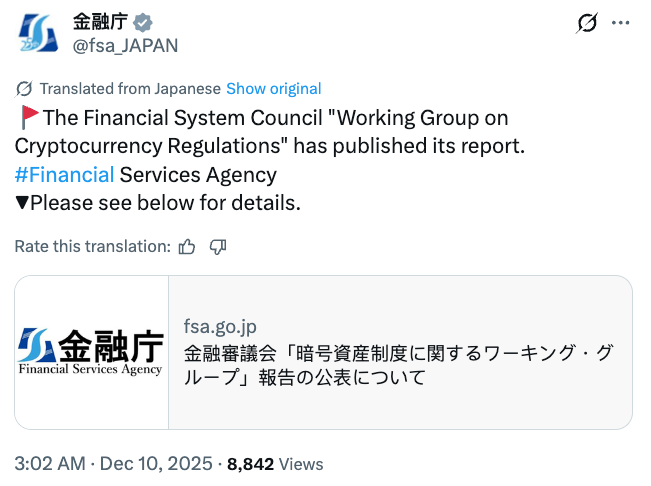
The plan was detailed in a new comprehensive report released Wednesday by the Financial Services Agency (FSA) via the Financial System Council’s Working Group. The document outlines how Japan intends to formally treat crypto assets as financial investment products, not just payment instruments, reflecting their increasing use in global and domestic markets.
According to the report, crypto assets today behave far more like investment vehicles than payments, and therefore require stronger consumer protections, stricter disclosures, and more robust oversight comparable to stock markets. Bringing crypto under the FIEA would represent a major tightening of rules across token issuance, exchange operations, disclosures, and market integrity.
A major focus of the transition is Initial Exchange Offerings (IEOs) — token sales run by crypto exchanges. Under the proposed framework, IEOs would face significantly increased transparency standards, including mandatory pre-sale disclosures that detail the core entities behind each project, token economics, issuance methods, and distribution structures. Exchanges would be required to conduct independent third-party code audits, and the process must incorporate feedback from self-regulatory bodies.
The stricter framework also extends responsibilities to token issuers, even if the project is decentralized. They will be required to publicly disclose their identity and explain the technical and economic structure of the tokens being sold — a major shift from the relatively flexible disclosures allowed today under the PSA.
Beyond IEOs, regulators would gain enhanced legal tools to target unregistered or offshore platforms, including decentralized exchanges (DEXs), which have traditionally operated outside Japan’s jurisdiction. The proposed rules would explicitly prohibit insider trading, aligning Japan with frameworks such as the EU’s MiCA and South Korea’s crypto regulations.
These reforms come as Japan debates the introduction of a flat 20% tax rate on crypto gains, potentially easing the country’s burdensome tax environment for digital asset traders. At the same time, the FSA signaled a cautious stance toward enabling derivatives tied to foreign crypto ETFs, labeling the underlying assets “not desirable.”
If implemented, the plan represents a complete reclassification of crypto within Japan’s financial system — shifting it firmly into the realm of regulated financial securities and signaling tighter scrutiny for both domestic and international operators.