
Klarna Launches USD Stablecoin on Stripe’s Tempo Blockchain
- Klarna becomes the first digital bank to issue a token on Stripe and Paradigm’s Tempo chain
- New stablecoin “KlarnaUSD” is pegged to the US dollar
- Tempo testnet launch is live, with mainnet coming in 2026
- Stablecoin built by Bridge, a Stripe-owned infrastructure provider
- Klarna explores stablecoins for internal payment efficiency
Klarna, one of Europe’s most well-known digital banks and payment companies, has officially entered the crypto space by launching its own USD-pegged stablecoin. This makes Klarna the first financial institution to issue a token on Tempo, the new layer-1 blockchain created by Stripe and Paradigm. The move marks a major expansion of Klarna’s long partnership with Stripe, which already covers payments across 26 global markets.
The new stablecoin, called KlarnaUSD, is currently operating on Tempo’s testnet. Klarna expects the stablecoin to launch on the upcoming Tempo mainnet in 2026. The token was built by Bridge, a stablecoin infrastructure provider owned by Stripe, showing how deeply integrated this new product is within the Stripe ecosystem. Klarna’s CEO, Sebastian Siemiatkowski, said that crypto technology has finally reached a stage where it can support fast, low-cost, and scalable payments, and he described this launch as the beginning of Klarna’s journey into the crypto world.
Klarna is widely known for its buy-now-pay-later (BNPL) model, as well as online checkout and consumer credit services. While launching its own stablecoin is a major milestone, the company says it is still at an early stage of exploring how the technology can support its business. According to a spokesperson, Klarna’s first focus is using stablecoins internally to reduce the cost of international payments. The company does not plan to integrate stablecoins into its BNPL installment services at this time.
The launch also comes during a year of rapid growth in the global stablecoin sector. In the United States, the GENIUS Act passed in July set clearer rules for stablecoin regulation, which encouraged more companies to issue their own tokens. MetaMask introduced its own stablecoin, mUSD, in September through Bridge and the M0 liquidity platform. That token already holds a market cap of more than $800 million. Meanwhile, Western Union announced it will launch a new stablecoin settlement system using Solana, with a USD-pegged token expected in 2026.
Competition among stablecoin issuers has increased sharply, and traditional payment companies are now entering the space. In July, Visa expanded its stablecoin settlement network by adding support for the Global Dollar token and enabling transactions across Stellar and Avalanche. These developments show how stablecoins are becoming a key part of the global payments landscape, with major brands racing to adopt and integrate blockchain-based settlement systems.
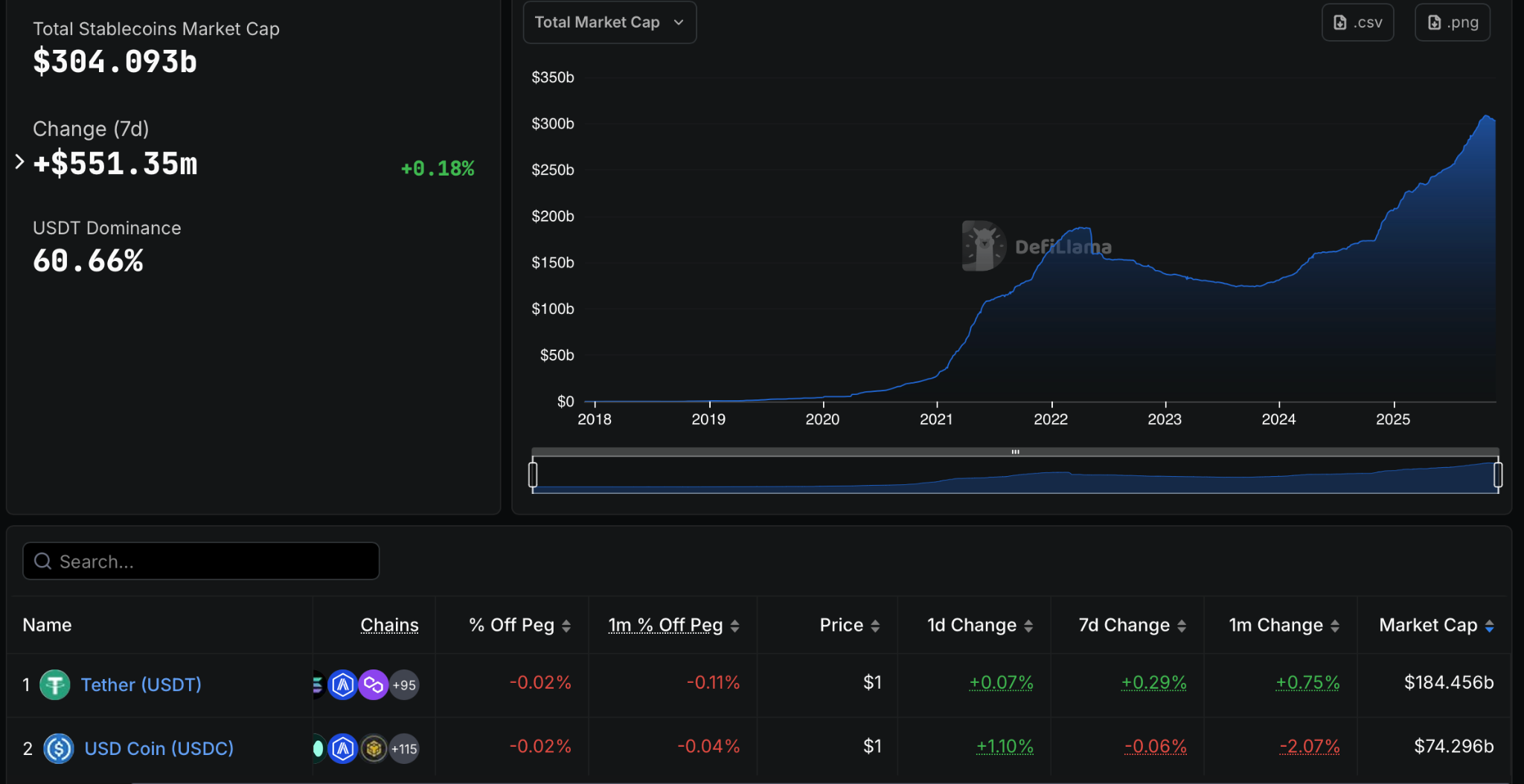
According to DefiLlama, the total stablecoin market is now valued at about $304 billion. Tether continues to dominate with around $184 billion in market cap, while Circle’s USDC holds roughly $74 billion. Klarna’s entry into this space highlights the growing interest from major fintech firms as they look to lower costs, improve settlement speed, and stay competitive in an industry that is rapidly shifting toward blockchain-based infrastructure.
Final Thought
Klarna’s move into stablecoins marks a major step for both the company and the wider fintech sector. By building on Stripe’s Tempo blockchain, Klarna is positioning itself early in the next phase of digital payments. While the technology will first be used internally, it signals a long-term strategy that could reshape how global payment companies use crypto to cut costs and optimize cross-border transactions.