
Mastercard partners with Polygon to simplify crypto wallet transfers
- Mastercard expands its Crypto Credential system to self-custody wallets
- Users can send and receive crypto using simple verified aliases instead of long wallet addresses
- Polygon provides the onchain infrastructure for the rollout
- Mercuryo handles identity verification and issues aliases
- Mastercard aims to make crypto transfers safer, simpler, and similar to traditional payments
- The program supports soulbound tokens as proof of wallet ownership
- Mastercard continues rapid expansion in Web3 through partnerships with Kraken, MetaMask, and Chainlink
- Chainlink integration enables onchain crypto purchases for 3B Mastercard cardholders
Mastercard is broadening its presence in the crypto ecosystem by extending its Crypto Credential program to self-custody wallets. This upgrade allows users to send and receive cryptocurrencies using verified, human-readable aliases instead of long hexadecimal wallet addresses. The goal is to make crypto transfers safer, easier and more familiar for everyday users.
Polygon is the first blockchain chosen to support the technical infrastructure for issuing and managing these aliases. According to Mastercard’s announcement, payments company Mercuryo will handle identity verification and issue the aliases to users once they complete verification.
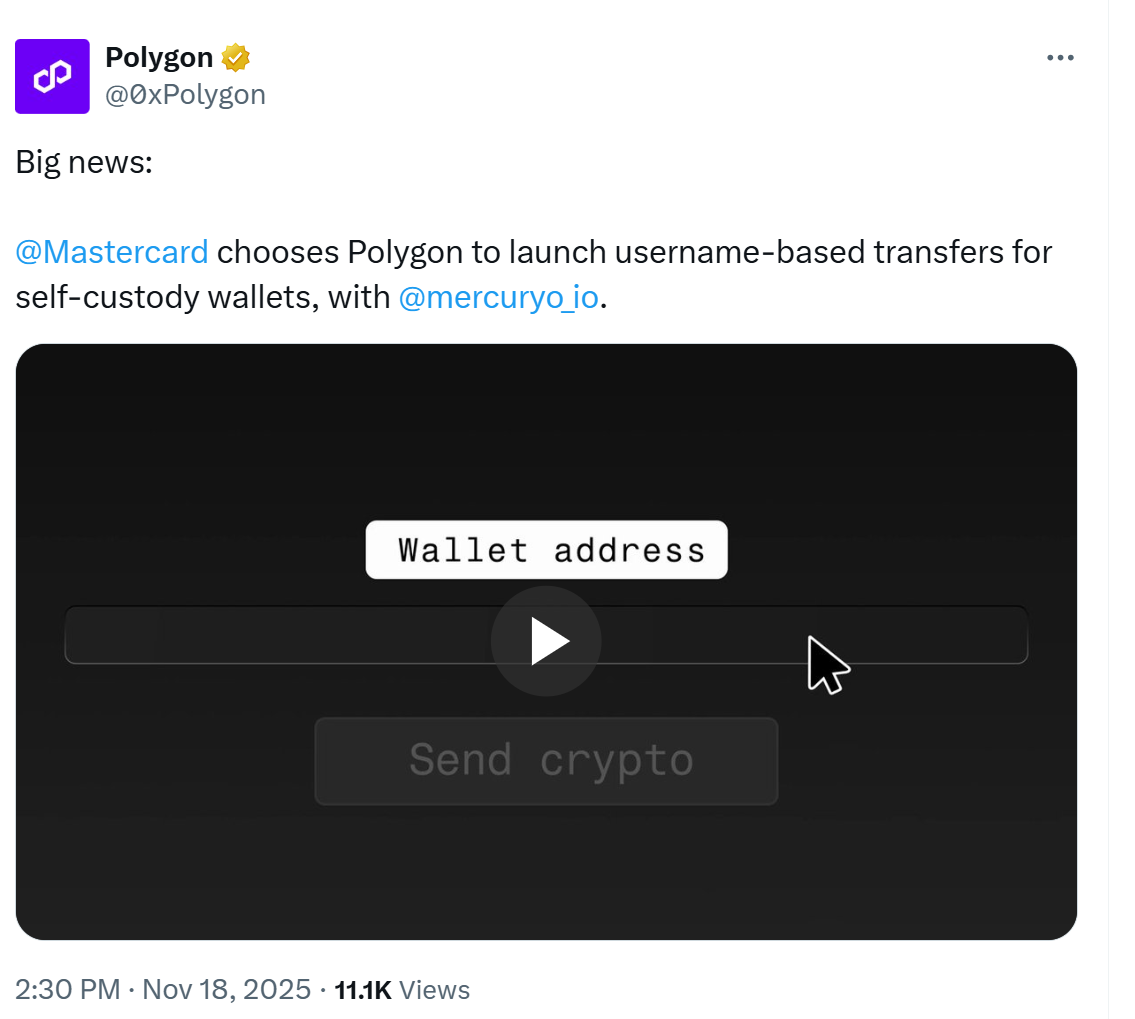
Raj Dhamodharan, Mastercard’s executive vice president for blockchain and digital assets, said the upgrade aims to reduce common mistakes caused by copying long wallet addresses. He noted that adding verification and alias support helps build more trust in digital token transfers and aligns the experience more closely with traditional payment flows.
After verification, users can link a simple alias to their self-custody wallet. They can also request a soulbound token (SBT) on Polygon, which serves as onchain proof that the wallet belongs to a verified individual. Polygon Labs CEO Marc Boiron described the partnership as an important step in making self-custody more accessible without sacrificing user control.
Mercuryo commented that demand for simple and secure crypto experiences continues to grow, especially solutions that preserve full ownership of wallets.
Mastercard has been accelerating its crypto initiatives during 2024 and 2025. The company launched crypto debit cards with Kraken across Europe and partnered with MetaMask to introduce a self-custody payments card. In addition, Mastercard worked with Chainlink earlier this year to allow its three billion cardholders to buy crypto directly onchain. That rollout uses several Web3 partners—including Shift4 Payments, Swapper Finance, XSwap, and ZeroHash—to provide fiat-to-crypto liquidity.
Chainlink stated that the version integrated through Swapper Finance is fully non-custodial and uses account abstraction to make the process feel more familiar to mainstream users.
Mastercard’s adoption of username-style aliases signals a push toward simplifying blockchain interactions while still supporting self-custody principles. With Polygon providing onchain support and Mercuryo handling verification, Mastercard aims to create an experience where crypto transfers feel as straightforward as sending funds in traditional finance.
Final Thought
Mastercard’s new alias system shows how large payment companies are working to reduce friction in crypto adoption. By replacing long addresses with simple usernames and using verified identity layers, Mastercard is building a bridge between traditional finance expectations and modern Web3 tools. This move could help self-custody wallets become safer and easier for millions of users.