Metis (METIS) Rises 15% on AI Payments and 20% Yield Boost
The Metis (METIS) token delivered a powerful, conviction-driven rally in the first week of November 2025, surging 15.21% over seven days to reach a price of $10.64. This performance was particularly notable as it occurred during a period of pervasive “fear” sentiment in the broader cryptocurrency market, alongside prolonged sideways trading for Ethereum (ETH) and sharp declines among major Layer 1 and Layer 2 assets.
The Fundamental Drivers of Metis’ Decoupling
Analysis suggests this surge was not merely speculative volatility, but a definitive case of fundamental decoupling. Structural project advancements successfully attracted capital despite severe negative macroeconomic headwinds. The rally was precipitated by the successful activation of a synergy between two major technological and economic milestones:
- Immediate Product Launch: The deployment of GMPayer—a cross-chain payment protocol specifically designed for AI agents—on November 3, 2025, provided an immediate, high-visibility utility case for the METIS token and the Metis infrastructure.
- Structural Token Utility Enhancement: The successful launch and incentivization of Decentralized Sequencer Mining (Phase 2), which requires token lockup and offers a significant yield (20% Mining Rewards Rate), created immediate and robust fundamental demand for the METIS token, effectively constricting liquid supply.
This combination of tangible AI integration and favorable tokenomics allowed Metis to establish a unique value proposition, attracting institutional capital seeking high-yield, utility-backed assets during a period of generalized market de-risking.
Empirical Analysis of METIS Price Action (November 1–7, 2025)
Observed Price Trajectory and Liquidity Flow
The price chart indicates that the Metis token successfully reversed a period of consolidation observed between November 1 and November 5, 2025, when the price hovered near $9.1396. A sharp upward reversal, initiated around November 6, propelled the price to $10.30 by November 7, delivering the 7-day gain of 15.21%.
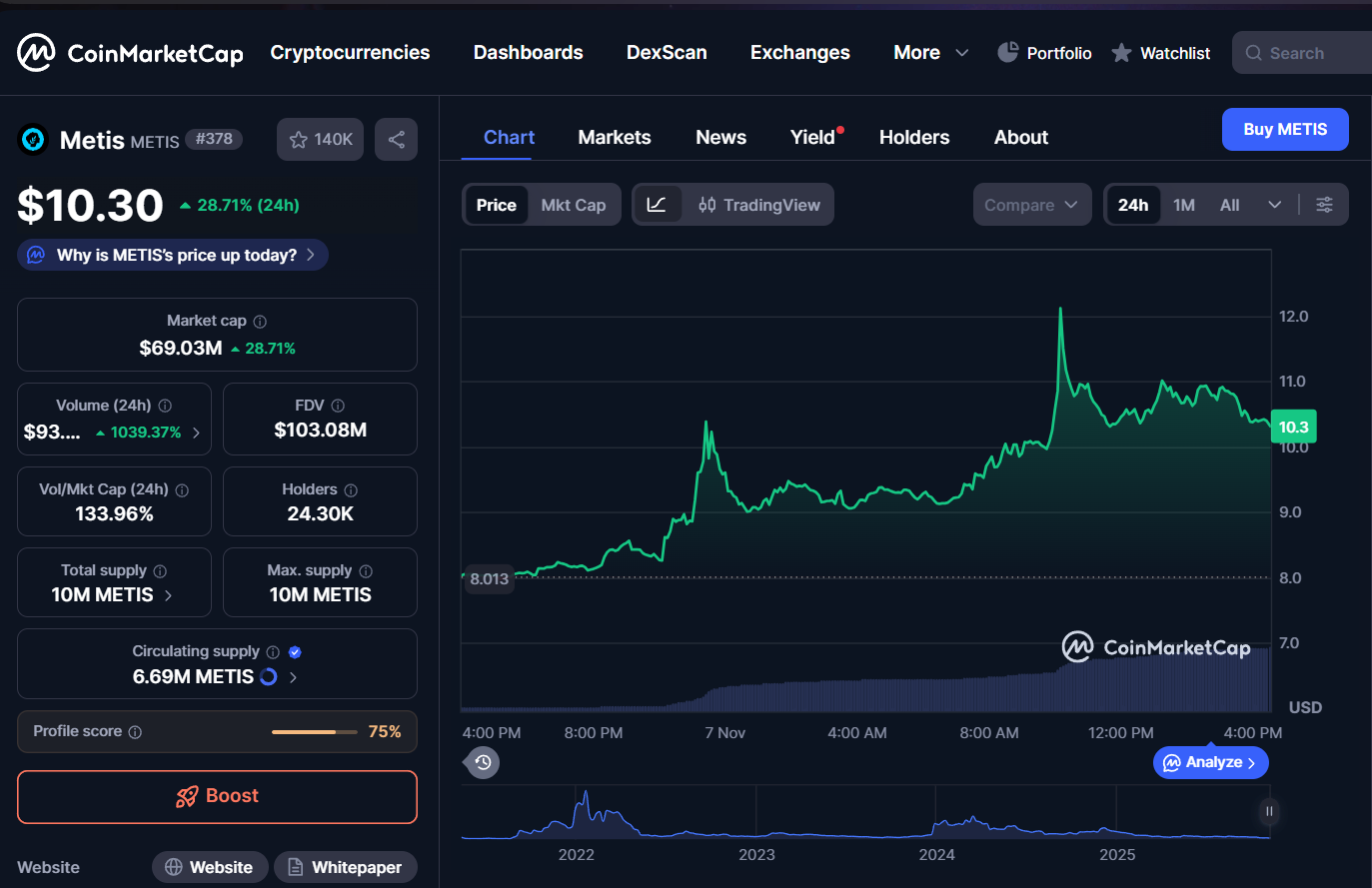
The conviction behind this rally is confirmed by a massive surge in trading activity. Data confirms that the 24-hour trading volume for METIS experienced a substantial increase of 227.30%, reaching $44,760,914. A price increase underpinned by liquidity absorption of this magnitude is typically associated with robust, high-conviction buying, rather than transient speculation.
Divergence from Consensus Forecasts
The METIS rally defied contemporary market expectations. Pre-existing consensus price prediction models were overwhelmingly conservative, projecting the METIS price for November 7, 2025, to be approximately $8.09. The actual price of $10.64 exceeded these conservative market predictions by over 31%. This failure of technical analysis models highlights the outsized impact of project-specific, fundamental developments like the successful product launch and tokenomics overhaul.
| Metric | Value (Approx. Nov 7, 2025) | Reference Period Change | Context/Implication |
| Price of METIS | $10.64 | +15.21$% (1W) | Strong bullish divergence during a bearish market. |
| 24h Trading Volume | $44.76M | +227.30% (1D) | High conviction and institutional interest. |
| Market Prediction (Nov 7) | $8.09 | N/A | Actual price exceeded predictions by over 31%. |
Immediate Causal Factor: The AI Infrastructure and Payments Launch
The immediate, high-impact news event contributing to the timing and magnitude of the rally was the successful deployment of key AI-centric infrastructure components.
Cross-Chain AI Payments Protocol (GMPayer) Deployment
The direct catalyst was the launch of GMPayer on November 3, 2025. This date falls precisely at the end of the consolidation phase and immediately precedes the sharp price appreciation.
GMPayer functions as a cross-chain payment protocol that facilitates transactions among decentralized AI agents, allowing them to use METIS or GOATED tokens directly. Crucially, this system utilizes trustless cross-chain settlement powered by Metis’s underlying decentralized sequencers. This mechanism creates an immediate and compelling utility demand loop for METIS tokens: as AI agents transact across chains using GMPayer, they directly generate demand for the network’s native tokens and utilize the core structural upgrade (DSeq).
The success of GMPayer validates Metis’ strategic shift toward integrating AI inference capabilities, building upon the previously activated Hyperion Testnet (an AI-optimized Layer 2 solution). This progress mitigates execution risk for investors betting on the AI narrative, leading to rapid capital inflow.
Structural Foundation: Decentralized Sequencer Mining and Tokenomics
While the AI launch was the trigger, the sustained strength of the METIS rally derives from structural improvements to the token’s utility and supply dynamics through the rollout of its Decentralized Sequencer (DSeq).
The Economic Mechanism of Sequencer Mining
Metis became the first-ever rollup platform to transition to a decentralized sequencer model with the launch of Phase 1 in 2024. Phase 2 introduced Sequencer Mining, transforming METIS into a productive, yield-bearing asset. The mechanism requires users to lock their METIS tokens via Liquid Staking Token (LST) providers to contribute to network security.
To ensure rapid adoption, Sequencer nodes benefit from an attractive 20% Mining Rewards Rate (MRR) in the first year. This high yield makes locking METIS tokens exceptionally appealing to liquidity providers. The structural integrity of the Sequencer Mining program is further reinforced by the MetisDAO Foundation’s launch of a $100 million Metis Ecosystem Development Fund (EDF). This fund specifically allocated 4.6 million METIS tokens to finance sequencer mining incentives, guaranteeing the longevity and attractiveness of the 20% MRR incentive structure and ensuring continuous demand for token lockup.
The immediate consequence of the Sequencer Mining requirement is the removal of a significant volume of METIS tokens from liquid circulation (token lockup), tightening the available supply.
Macroeconomic and Layer 2 Comparative Analysis: The Decoupling Narrative
The METIS price surge is best understood by contrasting its performance against the prevailing market conditions.
In late October and early November 2025, the broader crypto market was dominated by a “risk-off” trend, characterized by “fear” or “extreme fear”. This was fueled by macroeconomic pressures, including an uncertain U.S. Federal Reserve interest rate outlook.
Major assets reflected this sentiment:
- Bitcoin (BTC): Prices dropped below $104,000 and briefly under $101,000 by November 6, reigniting concerns about testing lower support levels.
- Ethereum (ETH): ETH was in a prolonged “trading sideways” phase, hovering around $3,297.90 on November 6, and struggling to sustain crucial resistance levels.
- Layer 2 Sector: The divergence was stark. L2 competitor Optimism (OP) was trading at approximately $0.37 on November 7, 2025, perilously close to its all-time low of $0.32.
This massive divergence demonstrates that capital was rapidly reallocating based on fundamental differentiation. In a fearful market where investors are withdrawing capital, assets that provide a robust, foundation-backed yield (like the 20% MRR from Sequencer Mining) become highly desirable. Capital flowed out of generalized Layer 2 exposure and rotated into METIS, which offered a strong yield opportunity and a robust technological narrative centered on AI and decentralization.
Conclusion and Forward-Looking Assessment
The Metis surge signals a turning point in how productive Layer 2 networks earn market trust. The combined force of the GMPayer rollout and the Decentralized Sequencer Mining initiative reshaped investor perception and unlocked a new valuation base for METIS.
Metis now operates as a revenue-generating infrastructure. Its sequencer model turns token holders into active contributors to network security while delivering measurable yield. The mechanism aligns capital efficiency with network expansion and encourages long-term commitment.
GMPayer adds immediate relevance through AI-driven transactions. Each exchange between autonomous agents increases demand for METIS and deepens its role in decentralized computation. The fusion of blockchain infrastructure and machine intelligence gives the token sustained purpose in a volatile market.
Enduring growth depends on steady AI adoption and responsible management of the 20 percent sequencer yield once incentives decline. Transparent reporting, consistent performance, and controlled emissions will determine durability beyond the initial acceleration phase.
If execution remains disciplined, Metis can rise above traditional Layer 2 competitors and become a foundational layer for the AI-powered Web3 economy. The synergy between yield, security, and applied technology positions it as a rare asset with both structural strength and forward momentum.