US bank regulator clears national banks to facilitate crypto transactions
- OCC confirms national banks can facilitate crypto trades as riskless principals.
- Banks can intermediate crypto trades without holding assets on balance sheets.
- Move expands what qualifies as the “business of banking” under existing law.
- Comes amid a broader US policy shift toward a more crypto-friendly stance.
In a major development for US crypto integration, the Office of the Comptroller of the Currency (OCC) has formally affirmed that national banks may facilitate cryptocurrency transactions as riskless principals — a role that lets banks execute customer crypto trades without taking assets onto their own balance sheets.
The interpretive letter, released Tuesday, states that banks can conduct a crypto trade with one customer while simultaneously executing an offsetting trade with another — a structure long used in traditional finance to provide brokerage services without market exposure. For the crypto industry, this effectively authorizes regulated banks to act as intermediaries for customer crypto trading under existing banking law.
The OCC emphasized that allowing this activity gives customers the option to transact through a fully regulated bank, instead of relying on less regulated exchanges or brokers. The agency notes that several applicants have argued this model would offer safer, more reliable crypto access as demand grows.
While the letter expands what banks may do, it also reinforces the compliance expectations: institutions must verify the legality of each crypto activity and ensure it falls within their chartered powers. The OCC highlighted counterparty credit risk, especially settlement risk, as the primary concern — but noted that banks already have deep experience managing these risks in traditional markets.
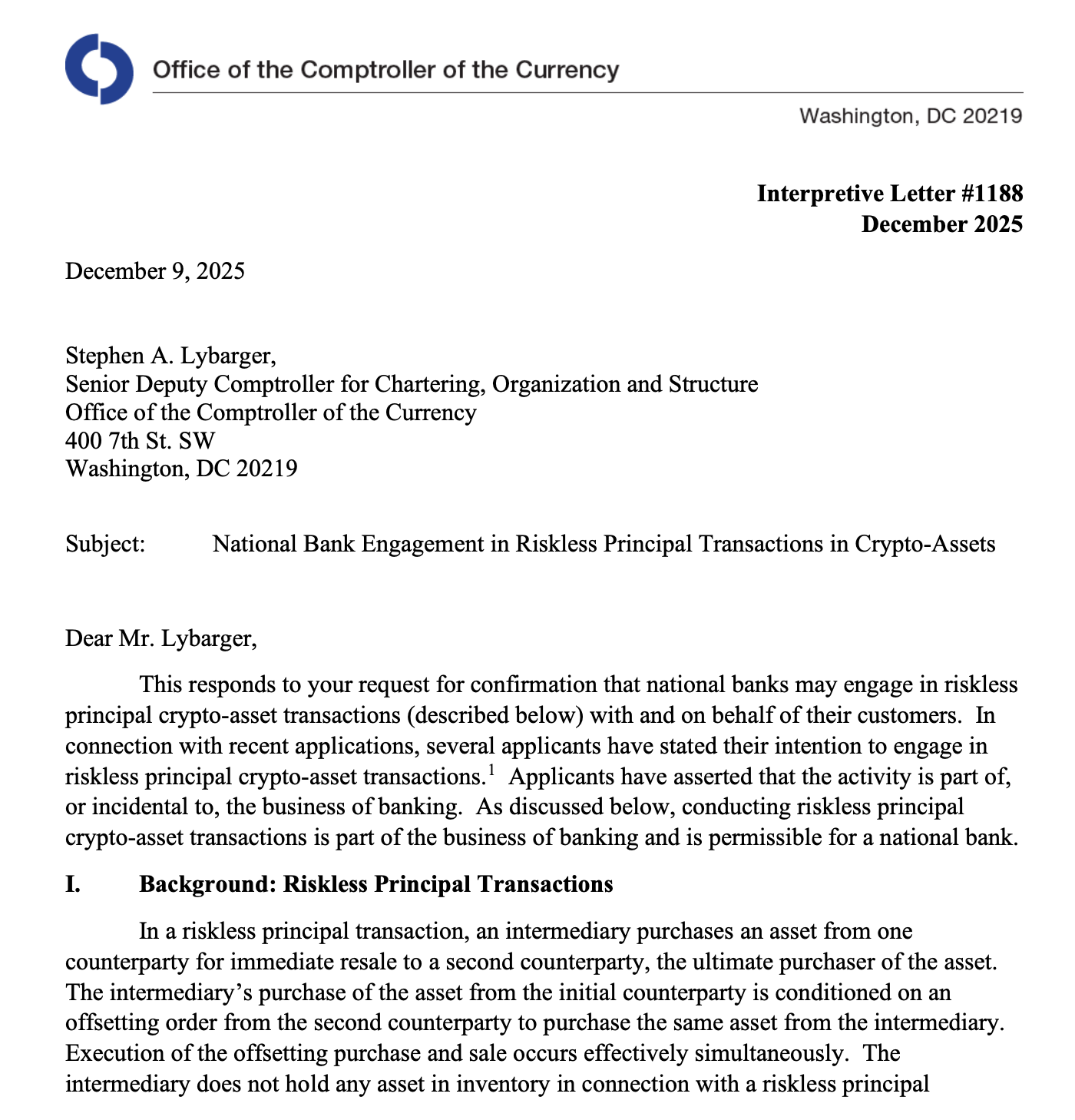
The regulator’s guidance draws from 12 U.S.C. § 24, which categorizes riskless principal activities as part of the “business of banking.” It also distinguishes crypto assets that qualify as securities, clarifying that riskless principal transactions involving securities were already permissible.
This interpretive letter arrives just one day after OCC head Jonathan Gould stated that crypto firms seeking a federal charter should be treated the same as traditional institutions, arguing that digital assets should not be viewed differently from systems banks have managed electronically for decades.
The policy shift fits into a broader reversal at the federal level. Under the Biden administration, critics frequently accused regulators of a de-facto “Operation Choke Point 2.0,” where banks faced heightened scrutiny for interacting with crypto companies. Since President Donald Trump took office in January, the government has taken a decisively more permissive approach — signaling an era where crypto is increasingly integrated into the regulated banking sector.