
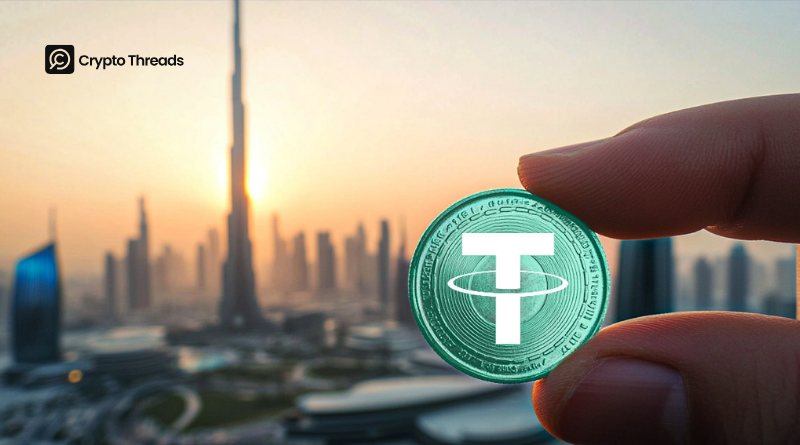
Tether’s USDt awarded key regulatory status in Abu Dhabi
- Abu Dhabi Global Market (ADGM) has formally recognized USDT as an “accepted fiat-referenced token.”
- Licensed firms within ADGM can now offer regulated trading, custody and settlement services involving USDT.
- The designation strengthens stablecoins’ role in payments, remittances and institutional finance across the UAE.
- Abu Dhabi regulators are also advancing Ripple’s RLUSD and a proposed dirham-pegged stablecoin backed by major local institutions.
- The UAE continues positioning itself as a leading global stablecoin and digital asset hub.
Tether’s USDt, the world’s largest stablecoin, has achieved a notable regulatory milestone in Abu Dhabi following its recognition by the Abu Dhabi Global Market (ADGM). Announced Monday, the designation establishes USDT as an “accepted fiat-referenced token,” granting regulated financial institutions permission to integrate the stablecoin into trading, custody and related services under ADGM oversight.
ADGM, which functions as an international financial center and free economic zone, has become a major destination for global digital asset firms seeking structured regulation and institutional-grade compliance. The new recognition strengthens USDT’s footing within one of the Middle East’s most active financial jurisdictions.
A step forward for institutional stablecoin use
The updated classification builds on ADGM’s previous acceptance of USDT as an approved virtual asset across its issuance networks, including Ethereum, Solana and Avalanche. The expanded designation creates a clearer framework for institutional use cases, particularly in cross-border payments, remittances, custody solutions and settlement operations.

Tether CEO Paolo Ardoino said the move “reinforces the role of stablecoins as essential components of today’s financial landscape,” highlighting their increasing adoption in both digital asset markets and traditional financial workflows. The recognition aligns with the UAE’s broader push to integrate blockchain-based instruments into regulated financial infrastructure.
Abu Dhabi widens its stablecoin ecosystem
USDt is not the only stablecoin advancing through Abu Dhabi’s regulatory channels. Local authorities recently approved Ripple’s RLUSD, another dollar-pegged token, as an accepted fiat-referenced instrument, enabling its use across institutional services.
Alongside these approvals, a consortium involving several of the emirate’s most influential financial entities — including ADQ, International Holding Company and First Abu Dhabi Bank — has announced plans to develop a dirham-pegged stablecoin, pending sign-off from the UAE Central Bank. The project reflects an effort to bolster the region’s digital currency infrastructure and create locally anchored settlement options for cross-border commerce.
The developments come at a time when the global stablecoin sector, now valued at more than $300 billion, is experiencing significant growth. According to DefiLlama data, this expansion has been driven by increased adoption in trading, remittances and institutional finance.
UAE solidifies role as a regional and global hub
The UAE — and Abu Dhabi in particular — continues to build a comprehensive regulatory environment designed to attract exchanges, custodians and digital asset service providers. ADGM has become a focal point for firms seeking predictable licensing standards amid broader global uncertainty surrounding stablecoin rules.
With the recognition of USDt and RLUSD, and the development of a dirham-backed stablecoin, Abu Dhabi is positioning itself to play a central role in the next phase of institutional stablecoin adoption, with implications for regional payments, global markets and regulated digital finance.
Final thought
Tether’s new regulatory status within ADGM strengthens both USDT’s institutional legitimacy and Abu Dhabi’s ambitions to lead in the stablecoin economy. As additional dollar- and dirham-pegged assets move through regulatory channels, the region is establishing itself as one of the clearest and most strategically positioned stablecoin jurisdictions worldwide.