
UK Passes Landmark Law Recognizing Crypto as Personal Property
- The UK officially passes a bill defining digital assets, including crypto and stablecoins, as personal property
- Royal assent granted, making the Property (Digital Assets etc) Bill law
- Advocates call it a “massive step forward” for crypto clarity and user protection
- The law codifies what courts previously recognized case-by-case
- Strengthens legal footing for ownership, theft recovery, insolvency, and estate handling
- Expected to boost the UK’s crypto ecosystem and regulatory framework
The United Kingdom has taken a major leap forward in its digital asset framework, officially recognizing cryptocurrencies and stablecoins as personal property under UK law. The Property (Digital Assets etc) Bill has received royal assent, meaning King Charles has formally approved it, and the bill is now legally binding.
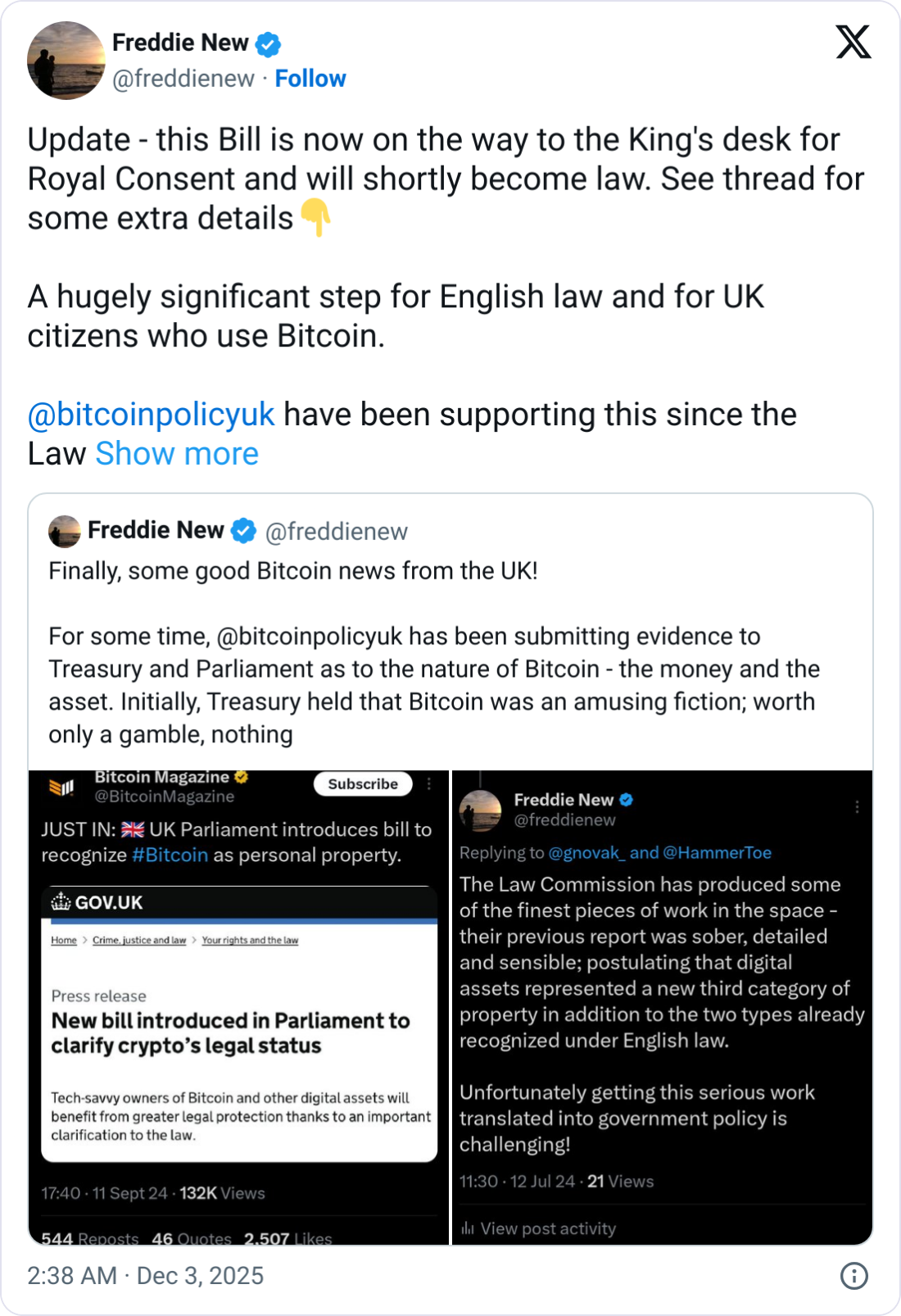
Crypto advocates described the move as a historic milestone. Freddie New, policy chief at Bitcoin Policy UK, said the law becoming official is a “massive step forward for Bitcoin in the United Kingdom,” noting that millions of users now have explicit legal protection.
Codifying what courts have already acknowledged
While UK courts have previously treated digital assets as property, this was done through individual case rulings rather than a clear, unified legal statute. Organizations like CryptoUK emphasized that the bill finally writes this principle into law, eliminating ambiguity.
The change follows recommendations by the Law Commission of England and Wales, which argued that digital assets should be treated as a new category of personal property to provide consistency across courts and better protect users.
Before this bill, crypto often fell into a gray zone between the two traditional categories of personal property:
- “Thing in possession” — tangible items like cars or physical goods
- “Thing in action” — contractual rights or financial claims
Digital assets fit neatly into neither category, but the new law confirms they are still covered as legally recognized property, closing a major gap in the UK’s legal infrastructure.
Stronger protections for ownership and asset recovery
One of the biggest impacts of the bill is the improved ability to handle disputes, theft, and insolvency cases involving digital assets. With personal property status, crypto holders now have clearer rights around:
- Proving ownership
- Recovering stolen or lost assets
- Including digital assets in estates or bankruptcy proceedings
- Transferring digital property with legal certainty
CryptoUK noted that the law gives “greater clarity and protection for consumers and investors,” providing the same confidence expected with traditional property.
By establishing a clear legal basis for ownership and transfer of digital assets, the UK positions itself as a more attractive environment for blockchain innovation. The updated framework supports tokenized real-world assets, new financial products, and safer digital markets.
The change comes at a time when crypto adoption in the UK continues to rise. Regulators reported that 12% of UK adults now own crypto, up from 10% previously, indicating accelerating national interest.
Earlier this year, the UK also unveiled plans for a comprehensive regulatory regime for crypto businesses — a move aimed at balancing consumer protection with fostering a globally competitive crypto economy.
Final Thought
The UK’s recognition of crypto as personal property marks a pivotal moment for digital asset regulation. By removing legal uncertainty and providing stronger protections for users, the country not only safeguards investors but also lays the groundwork for broader adoption and innovation. With clearer rules and growing national engagement, the UK is positioning itself as a leading jurisdiction for the future of digital finance.